SNQ: Scott Galloway’s “Notes on Being a Man”
by Miles Raymer
Summary:
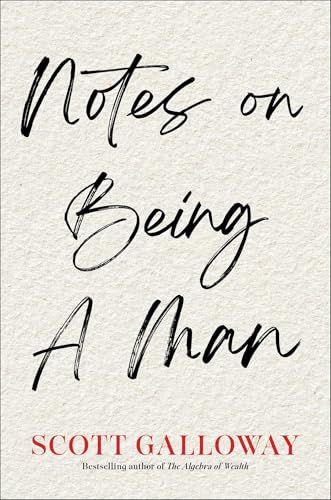
Scott Galloway’s Notes on Being a Man is a memoir that explores the intersection between Galloway’s personal story and America’s current masculinity crisis. Galloway offers lessons from his life and career to provide young men with a set of values and practices that can help them mature and thrive. The book centers on what Galloway calls the “three-legged stool” of masculinity: “Protect, Provide, and Procreate” (8). By pursuing these ideals in a healthy but ambitious fashion, Galloway argues that men can––and should––provide “surplus value” that redounds to the benefit of their families, friends, and communities. Written with vulnerability and appropriately brutal honesty, Notes on Being a Man makes a commendable contribution to the growing genre of nonfiction books seeking to promote ethical and durable versions of prosocial masculinity.
Key Concepts and Notes:
- I appreciated many aspects of this book, but my favorite was how Galloway repeatedly acknowledges the critical role that luck has played in his life. It’s refreshing to see someone so successful admit that it wasn’t entirely due to his own hard work and/or entrepreneurial acumen. Galloway gives himself credit for putting a lot into his career, but he also goes out of his way to highlight all the help and good fortune he had along the way. It’s also noteworthy that Galloway wasn’t born into a wealthy family and spent most of his childhood being raised by a single mother; he understands the crushing weight of scarcity mindset, has worked plenty of service jobs, and realizes how lucky he was to escape the American poverty trap.
- Most of the information about the masculinity crisis and Galloway’s advice for boys and young men is solid. The “three-legged stool” concept, paired with the emphasis on learning to create “surplus value,” provides an accessible foundation on which men can construct their identities and lifestyles in a fashion that is decidedly masculine in the positive sense. I had some minor points of disagreement here and there, but I can endorse Galloway’s overall approach.
- Throughout the book, Galloway argues that good men must always strive to be kind to others and to focus on the quality of our relationships. Galloway discovered the importance of kindness and relational health relatively late in life, after decades pursuing greedy goals and self-aggrandizement. He speaks from a place of hard-won wisdom regarding how much well-being he left on the table while he was laser-focused on getting rich.
- Notes on Being a Man devotes several chapters to exploring relational roles: being a son, being a romantic partner, being a friend, and being a father. Galloway writes with honesty and tenderness about all of these topics, and doesn’t shy away from disclosing the many ways he has faltered in his relational life. I particularly resonated with his messaging about taking care of one’s parents in their final years, prioritizing a female partner’s safety, stepping up to support friends when they are in need, and how becoming a father taught him to slow down and enjoy the simple moments of affection and connection. He also has a brief section on the importance of “fatherhood by proxy,” which is when men take an interest in the development of a boy or younger man who is not their biological child. This was especially validating for me because I benefited from the support of many dad-adjacent mentors growing up and now aspire to being a good “proxy dad” in both my personal and professional life.
- Like Galloway himself, Notes on Being a Man is an imperfect offering. The writing quality is uneven and the book is extremely repetitive. It could definitely have used some additional editing.
- I also think this book doesn’t quite seem to know what it wants to be. Most of it reads like a straight memoir, but then there are many random sections that inject information about the masculinity crisis and other general trends in American society. These transitions can be jarring and disorienting, with Galloway often failing to explain why he’s jumping back and forth between these two modes. I’ve read books that did this artfully, but Notes on Being a Man isn’t one of them.
- There are also aspects of Galloway’s life and character that might be dealbreakers for some readers. One problem is that, as far as I can tell, Galloway has never really built anything of tangible value to people outside the business world. His companies and projects all seem to be different twists on the same theme––”How can we make money and turn it into more money?”––which may compromise his credibility with some readers. He’s also transparent about acting like an asshole much of the time, which is off-putting even if he gets props for admitting it.
- Notes on Being a Man is a good book overall. For the right audience, it can serve as an excellent “father by proxy.”
Favorite Quotes:
There’s no such thing as “toxic masculinity”––that’s the emperor of all oxymorons. There’s cruelty, criminality, bullying, predation, and abuse of power. If you’re guilty of any of these things, or conflate being male with coarseness and savagery, you’re not masculine; you’re anti-masculine. (4)
Why are we so averse to identifying and celebrating what’s good about men and masculinity, and why does it matter? Because we won’t prosper if we convince boys and young men that they’re victims, or that they don’t have to be persistent and resilient, or that their perspective isn’t valuable. If we do, we’ll end up with a society of old people and zero economic growth. If we can’t convince young men of the honor involved and the unique contributions inherent in expressing what makes them male, we’ll lose them to niche, rabid online communities. Young men were instrumental in some of the most seminal events of the twentieth century, many if not all of which required collective effort, incredible bravery, risk-taking, aggression, and sacrifice. Can we acknowledge how extraordinarily important, skilled, strong, and decent most young men were carrying out the roles they played in helping create the world we live in? (4-5)
Female advancement in the past three decades is stunning. No one should want to slow the arrow of this trajectory. Overdue attention should be paid not just to girls and women but many other groups that history hasn’t benefited the same way it has men. But empathy isn’t a zero-sum game––it should be inclusive, not some Hunger Games competition for dwindling resources. Many people and groups today are suffering and in need of investment, attention, and support. But there’s no escaping the fact that we see––and are continuing to create––a generation of young men from all backgrounds who are (a) unbearably lonely, (b) not economically viable, (c) not emotionally viable, and (d) basically adrift. And there is nothing more dangerous than a lonely, broke young man. It’s a malevolent force in any society, and a truly terrifying one in a society addicted to social media and awash in guns and loutishness. (6-7)
Once, not terribly long ago, America loved the unremarkable. Do you want to take some chances? it asked. A risk or two? Do you have talent? Skills? Drive? We would then give the people who said yes the opportunity to blossom maybe later in life instead of identifying who is already remarkable at sixteen or seventeen and putting even more pressure on them to shock and awe us. Again, no organization or person or university can or should be the arbiter of any young person’s projected success. You never know when someone will decode the puzzle of himself and bloom. The goal, it seems to me, is to plant as much soil and as many nutrients around as many seeds as possible, as opposed to force-watering a few already half-ripened super-seeds and tending them in a hydroponic bubble, and good luck to all the others who are left unattended to dry, wilt, turn to powder, and blow away. Today, the American koan goes something like this: Let’s identify a super class of freakishly remarkable, prematurely accomplished young people and see if we can’t sculpt them into billionaires. Versus giving as many young people as possible a decent shot at becoming millionaires or finding various versions of success. (54)
Kindness and asking for help are two unheralded weapons for men. They’re big components of being male, and both go a long way. Unfortunately, many boys and men never figure this out. Be kind. Ask for help. Model yourself on––learn from––the people who’ve helped you. (56)
As you get older, the relationships you have with people you love and who love you overwhelm everything else in your life. It’s not something easily explained to a young person. And, unlike most things, we get better at love as we get older. At a minimum, we appreciate it more. (66)
Nobody is paying as much attention to your failures as you are, so fear them but don’t let them paralyze you. When you do fail, don’t feel you need to excuse your failures or blame others. Being gracious in victory is admirable. What’s harder, but can pay greater dividends, is being gracious in failure. Express gratitude to everyone who believed in you, and demonstrate grace to those who didn’t. (106-7)
When you die, it doesn’t matter how nice your home is. If at your exit you’re surrounded only by strangers under bright lights, it’s a disappointment. Of course, this isn’t an option for many people, but the goal is to die at home, surrounded by people who love you. You need to live well to die well, with a life filled with meaningful relationships where you were generous with people. (114)
Relationships (including with yourself) matter more than anything. But a close second is your relationship with the only temple you’ll ever have: your body. (120)
Therapy-speak permeates social media. Everyone’s a narcissist, a sociopath, has BPD, and knows their attachment style. At the same time, our culture is unsophisticated––genuinely stupid––about mental health. I’ve never seen a therapist––this from someone who for sixteen years, from twenty-nine to forty-five, didn’t cry once or feel much of anything. I have friends, though, who’ve gone or who go and have benefited enormously. Men often struggle to admit they need help or to talk about their feelings, seeing it as weakness or that there’s too big of a social stigma or therapy’s too expensive. For many, the foundational traits of masculinity, including absorbing the blows of others, can blur the line separating being male from silent suffering (or worse). Pride and shame make for a toxic cocktail. It can kill you.
But vulnerability is strength. By expanding the palette of what it means to be human and male (emphasis on human), you also get to show other men what’s possible via example. If they don’t get it, it’s their loss. (133-4)
Boys grow up expecting to be physically strong, capable of taking on any challenge. Mental strength matters just as much. I’ve always been drawn to the notion that action absorbs anxiety. Whenever you feel low, defeated, or frustrated, the best solution is to take action. Complaining is reactive; it wrecks momentum. Action restores agency, defeats inertia and self-criticism, and is always available. (146)
Men and women approach friendship differently. Men have it drilled into us from an early age that vulnerability and emotional connections are signs of weakness. They aren’t. Men with influence have an obligation to cleanse this bullshit version of masculinity from the zeitgeist. The decline in friendship is insidious, as it feeds on itself. Friendship is a muscle that strengthens with use but atrophies with age, but we must keep pulsing it. We have so many more opportunities and so much more fuel for our friendships when we are children and even as young adults, but we cannot stop building and using these muscles into and throughout adulthood. (151)
Supposedly each of us has in us bits of every material present at the dawn of the universe. It makes sense––at least when ingesting mushroom chocolates––that our matter will also be present in galaxies, stars, planets, and organisms birthed trillions of years from now. Our stories may or may not make the journey, but the emotions they inspire will become instinct, then DNA, and this matter will disperse. So the question is, distinct from the story you and others tell about yourself, how do you make people feel? When people encounter you, do they feel insecure or inspired? Do you leave people cold or comforted? Do you bring joy, harmony, love?
I’m in a deficit here––I’ve taken more than I’ve given. I have a debt to pay. I strive to provide surplus value now. I started with my boys and I’m working outward from there. Still time. It’s a comforting thought, that bits of us will live on and arrive at distant places trillions of years from now. We all have our longest journey ahead of us. When you get there, when you show up, what will be felt? (171)
Young men today have fewer venues in which to meet potential romantic partners. With fewer of them going to college or church, and more of them working remotely, men have less social interaction and no ability to build social capital. Those muscles of going out in public, meeting strangers, and going up to women with a fun, funny line can atrophy without practice. And fewer dates and romance means less intimacy, less sex, fewer marriages and kids. Straight young men are often interested in straight young women because they want to have sex. We tend to act as if there’s something wrong with that. There isn’t. Sex and the pursuit of it leads to romance and intimacy. It lights a fire under young men to better themselves to be more attractive to potential mates, who help them reach their potential. This intimacy often involves sacrifice, the forsaking-all-others stuff that comes when a pair of young people say, I choose you. This often leads to children. The most wonderful things in life, in my experience, lack rationality and structure. The person you fall for, and how it happens, will likely make less sense than almost any other important thing in your life. and that’s one of the reasons it’s so great. It speaks to you on a different level. Not what society or your parents want, but what you do. And, eventually, the answer to the most important question of your life: Who do you want to build a life with and have a family with? (184-5)
I’m no marriage expert but here’s my advice to young men: find a woman you want to have sex with, be affectionate with, and spend time with. A great marriage is one where you genuinely want the other person to win, where you celebrate and relive each other’s victories. You want to be on the same team––and then are a team. (191)
We pathologize males attracted to misogynistic communities as incels, potential mass shooters, and sex criminals, but these men are statistical outliers. However, we may be evolving a new species of asocial, asexual male: Homo solo. Homo solo’s inability to develop romantic skills means he’s primarily a danger to himself, as he’s likely to be less happy, or less money, and die sooner. Homo solo’s AI girlfriend never says no and is never tired, busy, or in a bad mood. In other words, she’s not human, and that obviates the risk of rejection and the other complexities of real-life relationships. (196)
The fastest blue-line path to a better world isn’t economic growth or a better phone. It’s more men becoming irrationally passionate about the well-being of a child who isn’t their own, getting involved in the life of a young man. Boys especially have a built-in hormone that causes them to stop listening to their parents, which usually kicks in around the age of fifteen. If you’re not their parents, they’re much more willing to listen to you. So coaches, uncles, teachers, Dad’s best friend, all become important to be around and step up. It’s fatherhood by proxy…
Being a man means acquiring the strength and skills––physical and mental fitness, and economic viability––you need so you can advocate for others. It means taking care of yourself first, followed by your immediate and/or extended family, then moving on to other people and your community. It means being the role model you wish there were more of in the world. If we want better men, we need older men to step up. Getting involved in the life of a boy or young man is the ultimate expression of masculinity and should be welcomed instead of distrusted. In New York, there are three times as many adult applicants to become Big Sisters as there are to become Big Brothers. We need to create a social zeitgeist whereby if a man is doing well he should feel compelled to cast his eyes down the mountain and assist those who are a quarter of the way up, some maybe out of breath. Mentorship programs are rife in the corporate world––so why not in the real world, too?
The good news is that needy and deserving young men are everywhere. Single mothers especially are looking for men to engage in their sons’ lives. It’s not unnatural; it’s natural. Boys will listen to their dad’s friends more than they will their own dads. You don’t have to be a baller or some amazing dude––just someone who’s trying to lead a good life and can pass on even half of what he knows. (234-5)
As you get older and begin to register the finite time we have, you want to slow time and have moments when you feel the beauty around and in you. Depression isn’t feeling sad but feeling nothing. Crying––especially in the company of, or thinking about, loved ones––feels healthy and joyous. (258)
Remember to be kind to others, and to yourselves. Like golf or piano, kindness is a practice. This was a big lesson for me because when I was your age, I wasn’t kind. Not mean, just not kind. As I got older, I made an effort to practice small acts of kindness until it became second nature. It’s a life hack hiding in plain sight as people notice, and it will put you in a room of opportunities.
Try to be more emotive––reckless even––with your emotions, with your concern, hurt, sadness, and admiration, especially with your family and friends. It’s what informs your life, knowing what’s important to you and inspires you. From the age of twenty-nine to forty-four, I didn’t cry or laugh out loud much. I see these years as mostly wasted as I was sleepwalking through life, barely conscious. I don’t want this for you. We have great advantages as a species, like our brain, opposable thumbs, willingness to cooperate, and a broader range of emotions. Use them. (263)
Great post! I especially liked this quote: “Boys grow up expecting to be physically strong, capable of taking on any challenge. Mental strength matters just as much. I’ve always been drawn to the notion that action absorbs anxiety. Whenever you feel low, defeated, or frustrated, the best solution is to take action. Complaining is reactive; it wrecks momentum. Action restores agency, defeats inertia and self-criticism, and is always available. (146)”
Thanks for reading, Andy! Glad you enjoyed this one. 🙂