Review: Adrian Tchaikovsky’s “Children of Strife”
by Miles Raymer
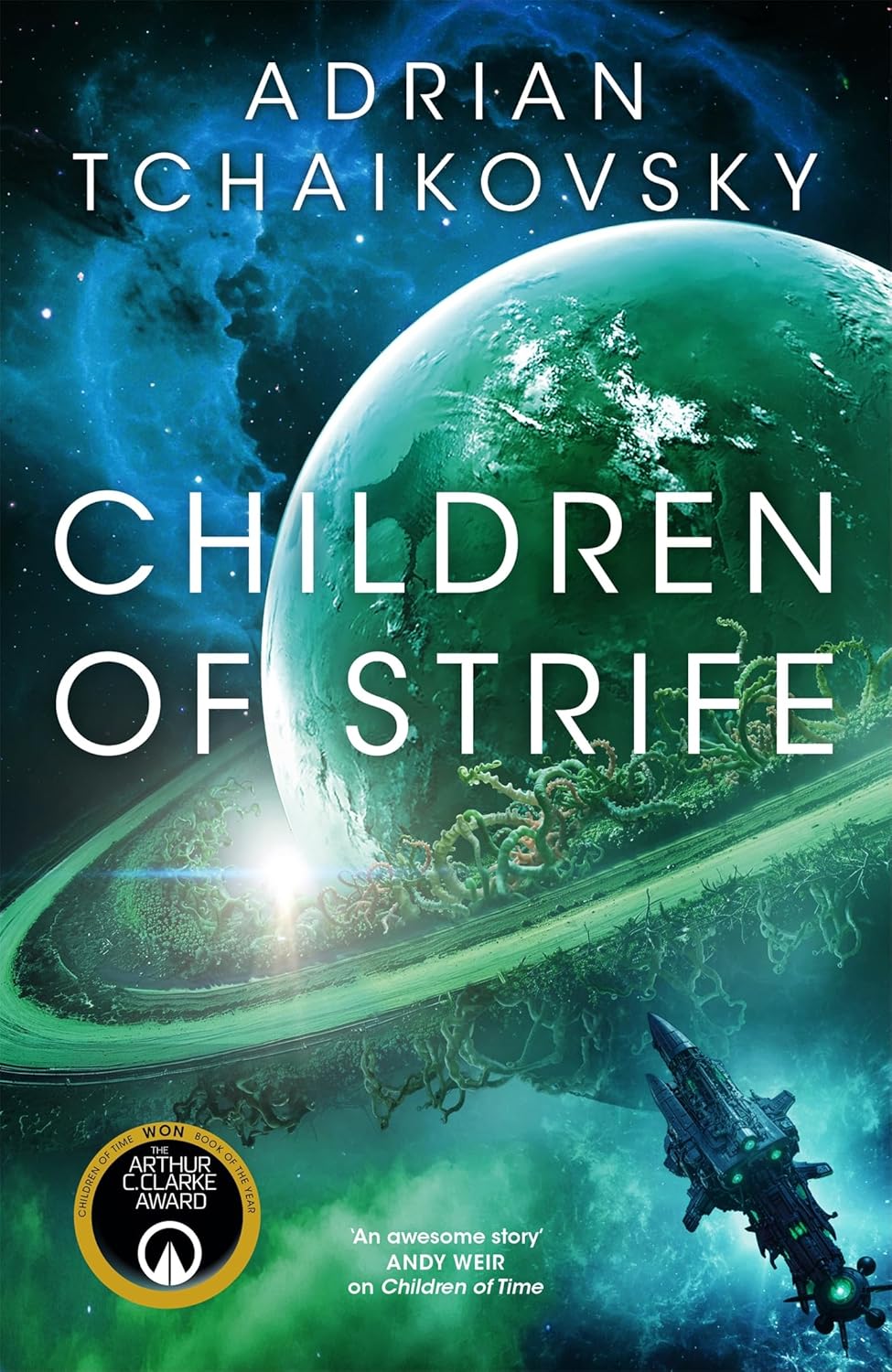
Adrian Tchaikovsky’s Children of Strife is the fourth novel in his Children of Time series.
Whenever a series reaches the very upper stratum of my science fiction pantheon, it can be a little scary to learn that a new installment has been published. It’s definitely exciting, but I also fear it might be disappointing. Will this be the one that misses? I wonder. Surely Tchaikovsky can’t keep this up. In response to my incredulity, I imagine a low, rumbling chuckle, one that spreads slowly but inexorably through the ripples of spacetime. The book opens––just one word after another (nothing fancy)––and my skepticism begins to crumble, replaced first by playful confusion, then by ravenous curiosity, and finally by dumbstruck joy. Yes, my fellow readers, it would appear Tchaikovsky really is that good.
One of this book’s many great qualities is how it compounds Tchaikovsky’s reputation as the unrivaled king of weird biological thought experiments. He has an incredible talent for applying evolutionary logic to a species or ecology, exploring the changes that can occur over deep time, and then finding a way to bootstrap it into a compelling narrative. On top of that, I feel like his writing quality has improved over time, with each book in the series getting better at delivering grim scenarios that resolve into ultimately hopeful messages about the power of cooperation and the futility of trying to assert dominance.
Children of Strife introduces several new elements to challenge a diverse crew of explorers from the interstellar “Panspecific” civilization that was born at the end of Children of Time. There is a mysterious planet with a tenacious form of plant life to be investigated, whose origins go all the way back to the ancient human civilization that enabled Avrana Kern’s first experiments with the “Uplift” nanovirus. The Nodan organism from Children of Ruin returns, playing a central role in the unfolding conflict. There’s a noble and gritty thread that follows the Key Crew of an Ark ship that is desperately trying to make it to this planet, ignorant of what they might encounter but determined to find out. And, best of all, Tchaikovsky introduces a character called Cato, an Uplifted mantis shrimp whose species was elevated by the same Kern nanovirus that boosted the Portiid spiders.
Thematically, Children of Strife is very much aligned with the previous novels in the series. Tchaikovsky explores the vain and monomaniacal attitudes of leaders who consider themselves to be at the center of a “Great Man” moment in history, this time through the eyes of Redina Kott, a crafty subordinate who understands the madness but also wants a piece of it for herself. In a desperate attempt to terraform the only planet to which they have access, Kott and her cantankerous collaborators invent a process called “Conflation” that allows human consciousness to merge with the planet’s ecology, thereby enabling rapid and wide-ranging exercises of conscious evolution. Tchaikovsky’s descriptions of the godlike high experienced during periods of Conflation are some of the trippiest passages I’ve come across in any novel. He brilliantly riffs on Clarke’s famous “third law,” exchanging “magic” for “nature”: Any sufficiently advanced technology is indistinguishable from nature.
Another major theme is the immortal tension between violence and cooperation in the process of conflict resolution. Cato takes center stage here, with relevance stemming from both his personal history and present captaincy of the ship investigating the mysterious planet. Raised in a hyperviolent warrior culture of technologically sophisticated mantis shrimps, Cato worships the thrill of battle but has also witnessed the catastrophic consequences of unchecked aggression. Tchaikovsky develops Cato’s character lovingly, showing how he can adopt new attitudes about the proper application of force while also staying true to his warrior values. The moments when Cato’s considerable capacity for violence is needed are nothing short of spectacular.
My last line of praise is for a piece of this book that touched me in a personal way. As a psychotherapist, I view the therapeutic alliance as a sacred connection between individuals that forms a foundation for healing, change, and growth. One way this happens is for the client to internalize a version of the therapist that they can carry with them and interact with long after the therapeutic process has ended. I have this connection with my own therapist and strive to create it with as many clients as I can. In Children of Strife, Tchaikovsky literalizes this idea in the strange and powerful connection between two of the main characters, Alis and her therapist, Mira:
Alis…has retained Mira within her. That part of Mira which has been with her all this time, and helps her know truth from falsehood when she looks on the world. Protecting her from the fear that everything surrounding her might be nothing more than a fantasy. (472)
It is truly moving to come across such a simple and profound description of the therapeutic relationship, and all the more so to find it in a science fiction novel. I’m so grateful that Tchaikovsky has continued to invest his time and attention in this series, and will gladly sail the stars with him on any future adventures.