Review: Lionel Shriver’s “A Better Life”
by Miles Raymer
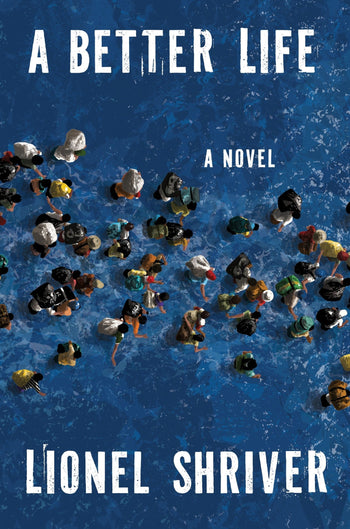
Lionel Shriver’s A Better Life is a work of political fiction. The setting is New York City in 2023, where the local government has initiated the “Big Apple, Big Heart” program as a response to a massive number of migrants flooding into the city. This program recruits NYC homeowners to offer up spare rooms to migrants in exchange for payments from the government, and is based on an actual proposal that was floated by then-mayor Eric Adams but never implemented.
Positing this alternate version of New York City’s near-past, Shriver imagines how such a proposal might have played out for one particular family living in a large house in Ditmas Park. Her protagonist is Nico Bonaventura, a twenty-something disaffected young man who’s living comfortably in his mother’s basement. After a promising boyhood and adolescence, Nico’s life has stalled due to a combination of lack of ambition, a modest but not insignificant inheritance from his grandfather, and an endearing capacity for contentment in the absence of the typical trappings of “success.” Nico likes to spend his time watching YouTube videos and taking long walks. He dabbles but is not devoted to the “manosphere.” He’s neither an “incel” nor a “gooner,” but his chronic online-ness, lack of engagement with material reality, and conservative political leanings land him in some vaguely adjacent ballpark.
Nico’s mother, Gloria, is an archetypal bleeding-heart liberal who jumps at the chance to increase her income by opening her home to a needy foreigner. Into this tinderbox tableau steps Martine Salgado, an energetic and clever migrant from Honduras seeking “a better life” in America. Martine’s introduction to the family home marks a fateful turn for the Bonaventuras, and from this point Shriver serves up a fiery condemnation of the attitudes and policies that fueled the Biden Administration’s failed immigration agenda.
Shriver made the rounds on a few of my favorite podcasts when this book was released, and I quickly knew it was something I should read. A Better Life explores the modern “masculinity crisis,” which fascinates me for both personal and professional reasons. It also addresses the thorny landscape of American immigration politics, an issue on which I have changed my opinion significantly in recent years. In many ways, I am the ideal reader for this novel. And while I don’t think it’s a masterpiece, Shriver’s story delivered on multiple levels that I found satisfying.
My favorite part of the book is Nico himself. It’s strange to call Nico a compelling protagonist given that his defining quality is a slouching lethargy that would not normally command a reader’s attention. But the truth is that I loved every minute of being inside Nico’s head, largely due to Shriver’s impressive capacity to imagine the inner life of a perplexingly untroubled young man. Armed with the dual defenses of wit and irony, Nico wields his intellectualism in the grand tradition of those who use their braininess to escape the distasteful chore of actually living. Nico is both self-aware and completely paralyzed, a juxtaposition that pairs nicely with Shriver’s clear empathy for him and unwillingness to let his hypocrisy slide. As Nico sleepwalks through the increasingly ridiculous facts of his post-Martine life, he begins to have moments of clarity and bursts of action that drag him into the land of the living. I pitied him but was also rooting for him every step of the way.
Martine is also a great character, a foil for Nico in many ways. Where Nico is lazy and complacent, Martine is active and industrial. Upon arriving at her new home, she wastes no time making herself useful and ingratiating herself to her hosts. Martine steamrolls right over Nico’s obvious skepticism, winning the affections of Gloria and Nico’s two sisters. After the initial honeymoon period, however, the Bonaventuras learn that Martine’s presence in their home comes with strings attached––or, perhaps the better word would be “chains.” Let’s just say that Martine is not the only Honduran that sets foot inside the Ditmas Park house. By the end, we learn that Martine and Nico are not really so different. They are both complicated people pursuing their respective versions of “a better life”––or, perhaps in Nico’s case, a “good enough life.”
A Better Life presents a challenging examination of how tribalism and polarization have degraded America’s public discourse and invaded even our most intimate relationships. Using immigration as her scalpel, Shriver flenses layer after layer of the Bonaventura family’s connective tissue. What she reveals is the terrifying capacity of political bias to drive us away from and pit us against those with whom we are supposed to have the most in common, and the most common cause. This is most acute in the relationship between Nico and Gloria, but also plays out in the relationships with Nico’s two sisters and his father. At its core, A Better Life is a family tragedy––not quite Shakespearean but reaching for it.
For those thinking that it’s perhaps nothing more than an anti-immigrant diatribe, I can say with confidence that it’s more than that, despite sometimes reading like one. Shriver wears her opinions on her sleeve, but she doesn’t go so far as to silence the opposition. Gloria and Nico’s sisters are allowed plenty of pages to make their case, even if Nico and his dad aren’t buying it.
There are a couple aspects of this novel that I think are worth criticizing. The first is that many of the characters flirt so much with stereotypes that they are sometimes unbelievable. This is perhaps forgivable for a novel with such an obvious political message, but it does weaken the book in places. A related problem is that there’s no serious representation of the “sane middle” approach to immigration that might form a compromise between Gloria’s naive generosity and Nico’s sour stances. This may be an accurate representation of what the American immigration debate often feels like these days––especially for people who spend too much time online––but it misses the reality that strong majorities of Americans in 2023 continued to support pathways to citizenship alongside stronger enforcement, reflecting a both/and orientation rather than the either/or framing that dominates political discourse. Most Americans want sensible and balanced immigration policies, but you probably wouldn’t come away from this book believing that if you didn’t know more about this complex subject.
The other thing I dislike about this book is how often it feels angry and bitter. You can also hear this in the way that Shriver speaks when she is interviewed. I’m not saying that anger and bitterness don’t have any place in this debate, but the frequency and intensity with which Shriver lays it on just left me feeling icky sometimes. The novel is an on-the-nose warning blaring “This could happen to you!” to countries that take a lax approach to mass migration. And perhaps that was Shriver’s intent, but I wonder if she might have produced a similarly solid novel that didn’t shy away from hard questions but asked them in a more curious and compassionate tone. I’m happy to say that Shriver’s conclusion, which is a bittersweet blend of betrayal and hopefulness, retains her delightful sense of irony without feeling too wrathful.
My last thought is for the reader who is offended by this book, perhaps to the point of wishing it had never been published. I can see why it would ruffle some feathers, but I’d also ask such a person to consider the surplus of available literature that depicts immigrants as ethical, hardworking, resilient, and heroic in their efforts to seek “a better life.” Is it really such a problem to have one book on the shelf that takes a different view?