SNQ: Spencer Greenberg and Jeremy Stevenson’s “The 12 Levers”
by Miles Raymer
Summary:
Spencer Greenberg and Jeremy Stevenson’s The 12 Levers is the end product of an extensive research project aimed at identifying the best psychological tools for improving human life. The book distills a massive amount of information from self-help and psychotherapy into “12 Levers” that we can pull to cope, heal, learn, grow, and reduce suffering.
For each Lever, Greenberg and Stevenson present a series of evidence-based techniques to give readers the most effective and reliable routes to self-improvement. The 12 Levers is one of the best psychology books I have ever read, and surely the “One Ring To Rule Them All” of self-help books. It cuts through the noise of a messy, inconsistent genre and delivers a clear and powerful signal that anyone can understand and benefit from.
Key Concepts and Notes:
- This book is the perfect answer to a problem I encountered while studying Counseling Psychology in graduate school. The more I learned about the various approaches to psychotherapy, the more I suspected that most modalities are constructed using the same (or very similar) concepts and practices, but deploy fancy terms and marketing language to differentiate themselves. I did notice some genuine and important distinctions, to be sure, but my overall impression was that most modalities are not nearly as unique as their creators and devotees would have us believe. Jeremy Stevenson appears to have had a similar experience: “While doing his PhD, [Jeremy] noticed that advocates of various therapies often claimed their approaches were revolutionary. But as he dove deeper into the techniques of each therapy, he once again found patterns. The techniques, while effective, were often repackaged, even if the terminology differed” (4). The 12 Levers solves this problem by identifying the perspectives and techniques that work across modalities, sharing them in plain language, and paving the way for improvement without overpromising. “We did the digging, sorting, and synthesizing so that you don’t have to,” they write. “You get the big picture of self-improvement strategies and the specifics of how to use them” (7).
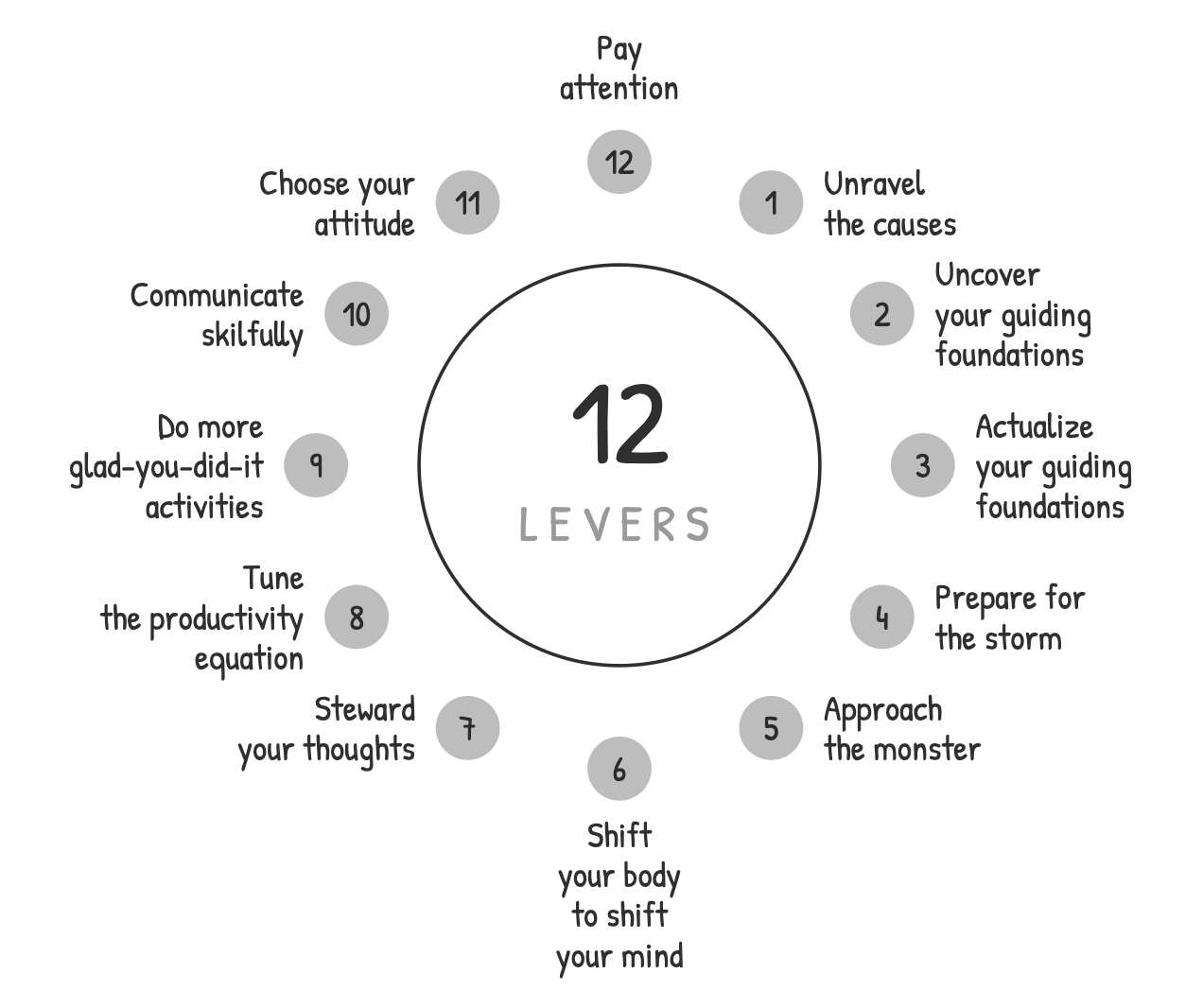
- Greenberg and Stevenson did their homework. In their own words: “We analyzed 106 books, twenty-three therapies, and numerous journal articles, videos, manuals, and other materials…Every time we encountered a technique, we extracted it to a spreadsheet. That spreadsheet grew to nearly five hundred techniques…After two years of research, we hit a saturation point––we stopped finding meaningfully new techniques, only variations of ones we’d already captured. From there, we began to synthesize, carefully reviewing each technique and grouping them based on their similarities. This is where we made the discovery that forms the foundation of this book: all 459 techniques fell into just twelve distinct categories. We called these categories Levers because they reflect the broad strategies for improving your life. By contrast, techniques are the specific ways to implement each Lever” (6). It’s possible that similar projects have been undertaken and I’m just not aware of them, but The 12 Levers is by far the most comprehensive and systematic examination of this topic that I’ve encountered.
- Greenberg and Stevenson carefully limit their scope to non-pharmacological and non-medical psychological tools. They provide a general overview of the psychological benefits of exercise and some specific movement and breathing techniques, but they scrupulously avoid any commentary on medications, supplements, or nutrition.
- They also assume that readers are ready and willing to consider making some changes to their lives; strictly speaking, this isn’t a “motivational” text.
- While Greenberg and Stevenson don’t deny the impact of past events, including trauma, their focus is on how readers can improve their lives in the present and going forward. “Too much digging up the past has a risk,” they write. “You can get stuck there. You can wind up ruminating over memories without improving your life today” (14). This attitude resonates deeply with my stance as a psychotherapist, which is unsurprising given that we share mutual influences from mindfulness and Stoicism.
- I love how The 12 Levers is anchored in values development and alignment. Greenberg and Stevenson emphasize that humans crave an ethical framework to inform our thoughts, feelings, and behaviors. When we can clearly articulate what we care most about and live in purposeful harmony with our values, we are on the path to the good life. I also appreciate their definition of “productivity” as “the measure of how much value your actions create per unit of time (per day, week, or year), according to whatever you fundamentally value” (152).
- It was rewarding to see the basic principles of exposure therapy featured so prominently in this book. We know this is the gold standard for certain conditions such as specific phobias and social anxiety, but I have found that exposure can be one of the most helpful directions for almost any therapeutic journey. Greenberg and Stevenson’s framing of “Approaching the Monster” generalizes exposure practices in a way that can help people overcome any kind of irrational fear.
- I have no reservations about the Levers themselves, but it bears noting that some readers may not connect with the specific techniques the book recommends. One thing I’ve learned from my clinical experience is that there are many doors that lead to the same destinations of healing and well-being. One door might be the perfect portal for one person but completely inaccessible to another. So if you find yourself drawn to working on a particular Lever, start with Greenberg and Stevenson’s recommendations, but if those don’t click it may be worthwhile to engage with the broader literature.
- Greenberg and Stevenson end with an unassailable reminder that while we do know a lot about how to improve human life, there are no shortcuts. “Knowing the Levers isn’t enough,” they insist. “There is one more essential ingredient: action. This is the most important thing. Without action, the Levers are useless” (297). I see this every week with clients. Those willing to take action improve, and those who don’t either stay stuck or get worse.
- This book deserves to become a nonfiction classic, one that will hopefully be read and adopted by people around the world. It’s an essential text for anyone searching for practical and effective ways to make life better.
Favorite Quotes:
Ultimately, we analyzed 106 books, twenty-three therapies, and numerous journal articles, videos, manuals, and other materials. These resources covered a wide range of topics, such as productivity, habit formation, mental health, and communication skills. Every time we encountered a technique, we extracted it to a spreadsheet. That spreadsheet grew to nearly five hundred techniques, ranging from reciting mantras to writing trauma accounts to gamifying your goals.
After two years of research, we hit a saturation point––we stopped finding meaningfully new techniques, only variations of ones we’d already captured. From there, we began to synthesize, carefully reviewing each technique and grouping them based on their similarities. This is where we made the discovery that forms the foundation of this book: all 459 techniques fell into just twelve distinct categories.
We called these categories Levers because they reflect the broad strategies for improving your life. By contrast, techniques are the specific ways to implement each Lever. For example, take Lever 6: Shift your Body to Shift your Mind––that’s the broad strategy. Then, one specific technique within this Lever is progressive muscle relaxation. To use an analogy: In weight training, think of lifting free weights as a Lever, and a barbell bench press as one technique within that Lever. Levers are the macro. Techniques are the micro.
Each Lever has many possible techniques. So once we uncovered the 12 Levers, we selected what we believe are the best techniques for each one. Our selections were based on a combination of current scientific research, Jeremy’s clinical experience (treating hundreds of clients over thousands of sessions), and Spencer’s work and research (creating self-improvement-related modules used by hundreds of thousands of people, and conducting numerous psychological studies on relevant topics).
One reason why we believe this book is valuable is that it’s both comprehensive and selective. It’s comprehensive because the 12 Levers cover all psychological approaches to improving your life, based on a massive analysis of self-help techniques. But it’s also selective because we’ve tried to curate the best techniques for each Lever. We did the digging, sorting, and synthesizing so that you don’t have to. You get the big picture of self-improvement strategies and the specifics of how to use them. (6-7)
Too much digging up the past has a risk: You can get stuck there. You can wind up ruminating over memories without improving your life today. (14)
Guiding foundations are like a lighthouse. Most of the time, we’re at sea just focusing on rowing. But once in a while, we need to look up at the lighthouse and see where to go. We might already be perfectly on track, though often we need to make course corrections, whether small or large. (26)
Even without an anxiety disorder, fear can stand between us and the type of life we actually want to live. It can prevent us from leaving bad relationships, forming closer friendships, starting fulfilling projects, and exploring new hobbies and experiences. Sometimes fear itself––not the thing being feared––is the problem. That’s why learning to “approach the monster” is so important. Of course, if the monster is a man with a knife beckoning you over, don’t approach him. The monster to approach is the one created by fear alone, not by actual danger. (72)
Your mind and body are deeply connected. Shifts in your physiology can shift your psychology, and vice versa. (88)
If you change your exaggerated and distorted thoughts to make them more realistic, you tend to feel better.
In CBT, cognitive restructuring is the technique for reframing negative thoughts. The goal, however, is not “positive thinking.” If you didn’t get that job you really wanted, you wouldn’t use cognitive restructuring to eliminate any initial feelings of disappointment. Those feelings are a natural and healthy response to not getting something you wanted.
But if you feel hopeless and depressed and those feelings persisted, that’s when cognitive restructuring can help. You can use it to target the extreme thoughts that often underlie disproportionate, lingering negative emotions. To put it simply, cognitive restructuring is not about pretending a bad thing is good––it’s about having the most helpful (but still accurate) view of the world possible. (110)
Of course, we don’t literally have other beings inside us, and each part is not a specific region of the brain. “Parts” is a useful metaphor because it can simplify things. You can use a single label to bundle together recurring patterns of beliefs, emotions, and behaviors (this is essentially the definition of a part).
More than that, parts work can change your relationship to internal experiences. Similar to mindfulness, thinking in terms of parts can create a healthy distance between you and your painful emotions, which can make them less overwhelming. Saying “part of me is anxious” can feel different from saying “I am anxious.” It can also shield your identity, in a healthy way. Difficult experiences like depression don’t need to define you as a person. Likewise, just because a part of you sometimes can be selfish doesn’t mean you are inherently a selfish person.
When you imagine a part of yourself as a person (particularly a child), it can activate all your pro-social machinery––empathy, compassion, understanding––in a way that imagining an abstract concept like an emotion does not. This is the biggest promise of parts work: It can transform your inner dialogue. In doing so, it can soothe anxiety, lift depression, or even help heal trauma. (128)
Postponing a thought won’t necessarily make the thought disappear. You can’t control every thought that enters your mind. But just because a negative thought keeps appearing, it doesn’t mean you have to think about it more or pay attention to it. You can briefly acknowledge the thought, postpone it until later, and then return your attention to something more useful or interesting. (145)
Productivity isn’t just about working harder or longer or producing “output” for its own sake. Defined in the healthiest way, productivity is the measure of how much value your actions create per unit of time (per day, week, or year), according to whatever you fundamentally value. If you create more of what you value, then you’ve increased your productivity. (151-2)
The true path to sustainable and meaningful productivity is accepting our limits. We are limited––by time, energy, and focus––limited in how much we can realistically achieve in a lifetime. This means making hard choices and letting some things go, maybe many things. But once we accept these limitations, we can also let go of the doomed endeavor of trying to do everything, and just focus on the few things that matter to us most. (163)
The most important principle to keep in mind if you’re underactive is: Action often proceeds motivation. In other words, don’t wait until you’re motivated. Motivation will come later, once you get started. Especially if you’re depressed, you likely won’t want to do whatever you’ve scheduled. Your mind will try to convince you it’s not worth it. But as Jeremy tells clients, a key driver of recovery is simply a willingness to do things that you don’t want to do. If you can tolerate that––temporarily––you’re much more likely to get the change you seek. (179)
Follow a plan, not a mood. After you act, the good feelings tend to follow. (180)
The connection between relationship quality and happiness is well established across genders and cultures. What is less well established, however, is how to build better relationships.
There are many ways to improve social connections, such as planning fun activities to do with people you like. But there’s one social activity that humans do more than any other, and it shapes nearly every relationship we have: talking…
No matter where you’re from or how old you are, conversations are key to forming and deepening relationships of all types. Better conversations create closer friendships and stronger romantic bonds. (184-5)
While assertiveness has its own drawbacks (it can be intimidating and others may still react negatively), it’s the option most likely to achieve the outcomes you want, like fair treatment, valuable opportunities, and healthier relationships. Assertiveness is the best default communication style for everyday situations because it balances your needs with the needs of others. (199)
There’s always one opportunity hardship provides: training in resilience. You can strive to endure this adversity with poise and steadiness. So the next time your car breaks down, your waiter is rude, or your partner is late, try telling yourself: “This is training.” The more resilience you can bring to this adversity, the more prepared you’ll be for the adversity to come. (239)
Given that excessive self-focused attention can cause negative emotions, an explicit goal in several types of therapy is to shift people away from the internal and toward the external. When you focus away from body sensations and thoughts, and toward external sights and sounds, you can reduce your distress. (273)
This radical shift––changing your relationship to experience––is fundamentally what mindfulness is about.
Mindfulness is a type of attention that involves changing your relationship to experience such that you’re (1) accepting whatever arises, while (2) knowing you’re having an experience. (278-9)
Remember: Knowing the Levers isn’t enough. There is one more essential ingredient: action. This is the most important thing. Without action, the Levers are useless. (297)