Review: Brandon Sanderson’s “Rhythm of War”
by Miles Raymer
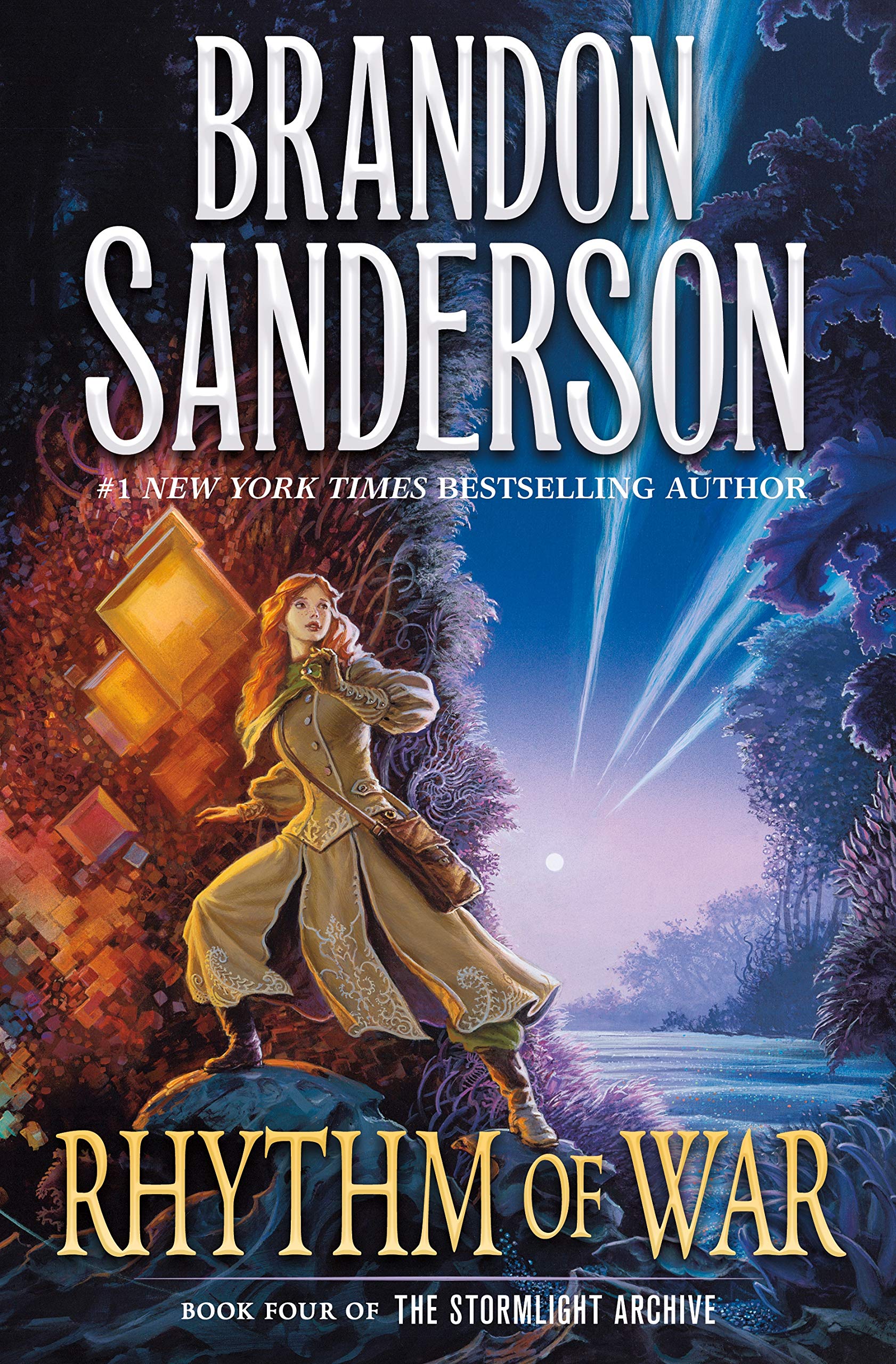
Brandon Sanderson’s Rhythm of War is the fourth book in his Stormlight Archive series. As the war between the humans and the forces of Odium rages, Sanderson’s worldbuilding continues to evolve, along with his deep and varied cast of characters. The result is a sprawling narrative that offers exciting new insights and developments, but that also veers away from some of the characters and relationships that made me fall in love with the series in the first place.
Given my professional work as a psychotherapist, it will surprise no one that Kaladin’s quest to acknowledge the realities of war trauma was my favorite aspect of Rhythm of War. Sanderson smartly depicts what it feels like to struggle with the effects of depression and posttraumatic stress in a cultural context where there’s neither appropriate terminology nor humane practices for identifying and responding to it. I was slightly annoyed that Kaladin’s development in this direction was delayed by one of the book’s central conflicts, but happy that he appeared to be returning to this path by novel’s end.
Another strong quality is the expansion of our understanding of Urithiru, the mighty and mysterious mountain stronghold where our heroes take refuge from the forces of Odium. We largely learn about this setting through the experiences and experiments of Navani, who takes center stage in Rhythm of War as a much more important character than in previous installments. This was an excellent choice by Sanderson, bringing a beautiful blend of concepts from music, mathematics, and the scientific method into harmony as Navani discovers more not just about Urithiru itself, but about the fundamental nature of Roshar. Dalinar, who is not featured as heavily in this book as in Oathbringer, nevertheless remains a strong presence and complement to Navani’s journey; their relationship is lovely.
In my view, Rhythm of War stumbles on two different fronts. The first is that, after sending them off on a promising mission, Sanderson all but abandons two of the series’ absolute best characters in the book’s second half. Shallan and Adolin, now married and beguiling as ever, must travel through Shadesmar in an attempt to win spren allies who can help turn the tide of the war. As far as it goes, their plotline is terrific; the problem is that there’s not nearly enough of it. Sanderson, you can’t just make a guy like me fall for a stud like Adolin and then slash his pagecount like that. I need more fashion tips and wholesome vibes! And Shallan’s ongoing identity crisis is great, but I didn’t get enough time with her to truly enjoy it.
What I couldn’t figure out is why Sanderson sidelines Shallan and Adolin while simultaneously elevating Venli and Eshonai––two “listeners” whose backstory and present doings become a major focus of Rhythm of War. It’s not that I don’t trust Sanderson to have a plan for this, and I also tend to love a good redemption narrative, which seems to be where he’s going with Venli. But the reality is that I found these chapters on average to be very boring, and I was always rushing through them to get to whatever was next. I hope this storyline either fades considerably or gets a lot more compelling as the series continues.
Flaws and all, Rhythm of War is a wild ride that pushes the Stormlight Archive forward in fascinating and fun ways. Despite my frustrations, it’s probably my favorite of the series so far; the continued depth of the worldbuilding and the ongoing character development are just so engaging and satisfying. I’ll certainly be picking up Wind and Truth at some point to see what happens next!