Review: Scott Hawkins’s “Blacktail”
by Miles Raymer
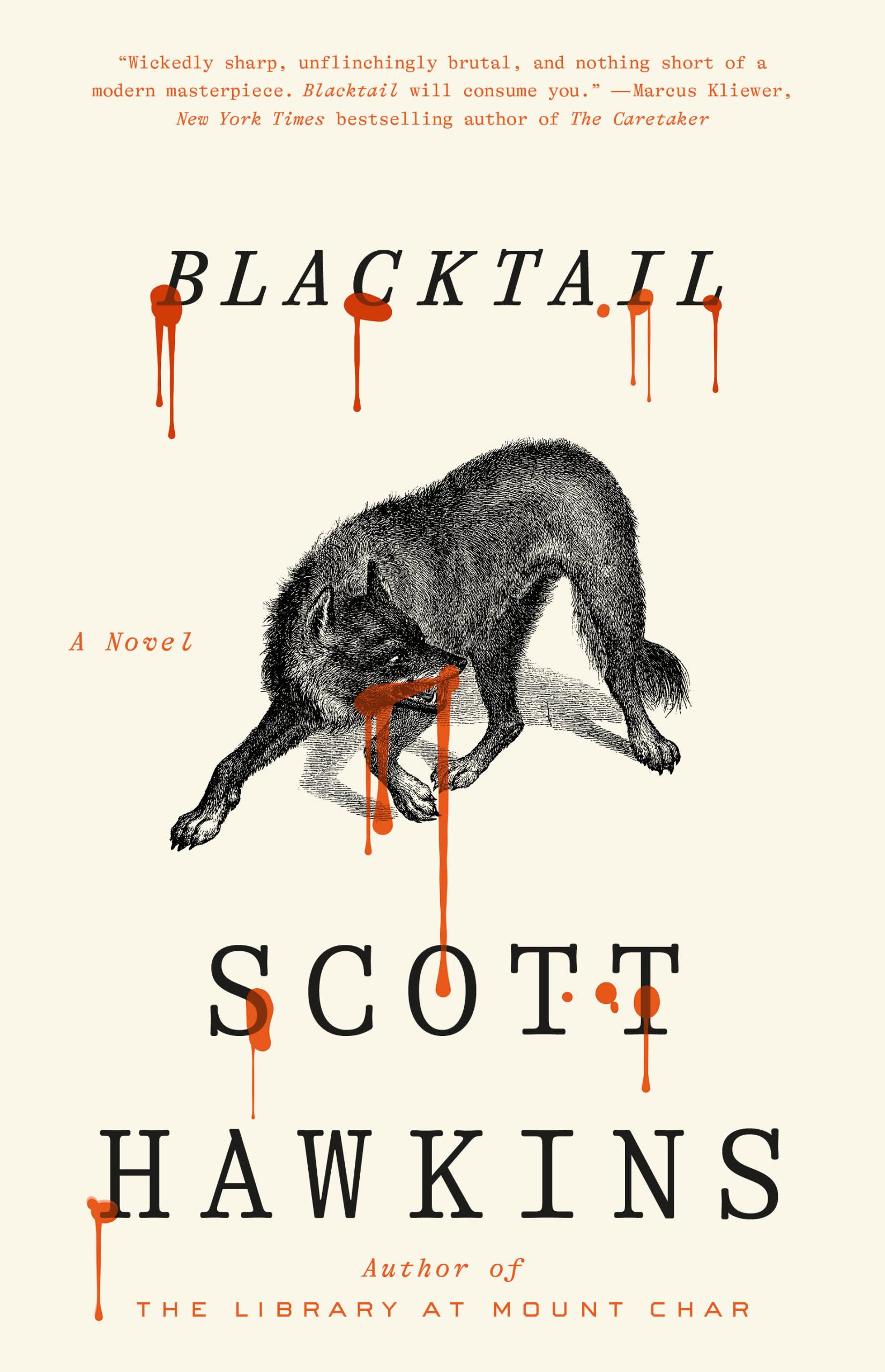
After discovering and loving Scott Hawkins’s first novel earlier this year, I was excited to see what he had cooked up for his new novel. Blacktail is a fable in which the titular character, a powerful and intrepid half-wolf, suffers a series of personal tragedies at the hands of the “two-legs” (humans). Humans are taking over Earth and leaving little room for the wilderness in which Blacktail and other predators can engage in the ancient way of life they call “the hunt.” After a strange encounter with the Old Kitty Mother, a mystical and witchy feline, Blacktail sets out on a quest to find and wake the Forest God in hopes of annihilating the humans and revitalizing the hunt.
Blacktail is a novel that I struggled to get through. Hawkins’s writing is stripped down in a way befitting a fable, so it’s not challenging in a technical sense. But the story is unrelentingly brutal, leaving barely enough time to consider the implications of one horrific event before plunging into the next. With the exception of Blacktail, the characters are promising but transient, never lingering long enough to become full-fledged contributors to the narrative. And Blacktail himself, well, he’s something all right. Something summoned from the darkest, most primeval corners of the human imagination.
There is a lot of cleverness and creativity packed into this short book, and some of the scenes are memorable. But I ultimately found it to be repellent and disappointing. I can’t say too much without spoiling the plot, but I felt that the novel trades one simplistic and extreme moral universe for another, supplanting a false “humans versus nature” dichotomy with a morality governed entirely by a romanticized “state of nature.” The philosopher Thomas Hobbes thought reason was what rescued us from the state of nature, where life is “nasty, brutish, and short.” Blacktail reverses this argument, treating reason as the disease and nature as the cure. This has been done many times by many writers, and it’s always been juvenile and boring.
I experienced this novel as a disturbing depiction, and at times an outright endorsement, of the anti-humanism and nihilism that arise when we give up on confronting the ethical nuances and uncertainties of real life. Whatever Hawkins intended, I found absolutely nothing and no one to root for. Reading Blacktail felt like watching a petulant child discover the existence of evil, throw a tantrum, and demand the end of the world.