Review: Scott Hawkins’s “The Library at Mount Char”
by Miles Raymer
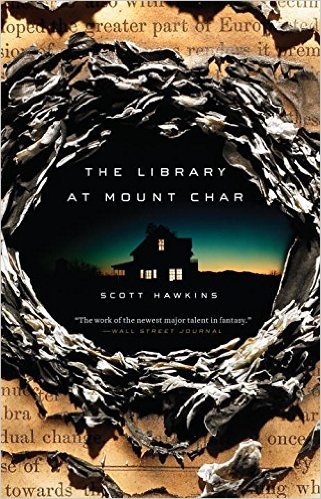
My wife is a librarian, so one of her great joys is finding new books to recommend to people. And she’s damned good at it. She reads widely and has developed a canny ability to internalize someone’s preferences and point them in the direction of something new that they will most likely enjoy. Usually her recommendations are targeted based on her audience, but every now and then, she reads a book that she just can’t stop thinking or talking about. And this book gets recommended to everyone. Scott Hawkins’s The Library at Mount Char is her latest, and by my lights it lived up to the hype.
The Library at Mount Char is an extremely clever work of dark fantasy that is an absolute pleasure to read. The protagonists are Carolyn and Steve, two Americans who seem to live in the same world but who, we quickly learn, move through reality with very different capacities and priorities. When Carolyn recruits Steve to help her commit a minor break-in, Steve finds himself thrown into a tangled web of power dynamics playing out between Carolyn and her adopted siblings. This bizarre “family” is full of weirdos with remarkable abilities such as talking to animals, killing with unmatched prowess, and resurrecting people from death. We learn that Carolyn and her siblings were adopted by an enigmatic figure named Father, who assigned each of them a “catalog” to study, which is where their abilities came from. And Father has now gone missing, leaving his children to figure out what to do next.
I won’t say much more about the plot because this is one of those books that is easy to spoil, and spoiling it would be a shame. It’s an elegant, surprising, and funny narrative, seamlessly weaving the tropes of modern American fiction with fantastic elements that feel genuinely fresh. The vibe is a bit like Neil Gaiman’s American Gods, but Mount Char is superior in every way. And the ending is brilliant and moving, obviously the result of careful planning and deft execution from Hawkins.
The Library at Mount Char explores themes of childhood trauma, the high cost of learning hard lessons, the difficulty of staying compassionate in an often-harsh world, and the question of what people with immense power owe to people who are innocent bystanders in conflicts they cannot begin to comprehend. But more than anything, the novel is crafted to remind us that reality is so much bigger and stranger than we can ever know. “However deeply you understand the universe,” Hawkins writes, “however many mysteries you solve, there will always be another, deeper mystery behind it” (368).