SNQ: David McKittrick and David McVea’s “Making Sense of the Troubles”
by Miles Raymer
Summary:
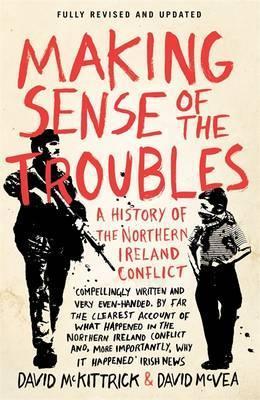
David McKittrick and David McVea’s Making Sense of the Troubles is a chronological history of the conflict in Northern Ireland from 1921 to 2012. Taking a measured and neutral approach, McKittrick and McVea trace the origins, central dynamics, key events, and main figures of the troubles. Making Sense of the Troubles is a valuable examination of how sectarian division keeps societies locked in cycles of brutal violence, and also of the concrete steps a society can take to slowly pull itself out of chaos. It’s a tragic but ultimately hopeful narrative about transitioning from an explicitly unfair society built on active discrimination to “a fairer society with arguably (and hopefully) less hatred and resentment” (307).
Key Concepts and Notes:
- After having this book recommended to me by a dear friend who has studied the troubles extensively, I picked it up with a very clear agenda in mind. Over the last year, many of my favorite political commentators have wondered whether America is descending not into a full-blown civil war, but rather into our own version of Northern Ireland’s troubles. And although I’m not sure if this is a likely outcome, I take it seriously enough to wonder what we can learn from the troubles that might help us avoid something similar. So my thoughts here should be contextualized within a “what could this history mean for 21st-century America?” mindset.
- Making Sense of the Troubles is a solid work of historical scholarship in every way. McKittrick and McVea are evenhanded in their descriptions of events, make an appropriate effort to understand all sides of the conflict, and include an extensive chronology, tables with death statistics, a glossary, and index.
- Readers should be prepared for a relentless series of terrible events, from gruesome bombings to horrifically intimate murders. The book can be tough reading, even with McKittrick and McVea’s “just the facts” style of delivery.
- The rest of my review will be broken into two lists. The first list––Dynamics of Division––shares my observations of themes and dynamics that created and perpetuated violent tribalism during the troubles, and the second list––Dynamics of Resolution––explains what I learned about how these dynamics were ultimately subverted and overcome.
- Dynamics of Division
––A fearful, insecure majority (Protestants/Unionists) and an embittered, disenfranchised minority (Catholics/Nationalists) is a dangerous combination. When the side in power refuses to push its own members toward reasonable reforms that would lessen pressure on the minority, everything gets worse.
––Consolidated control of government leads to systemic discrimination––in Northern Ireland this meant gerrymandering, housing discrimination, and jobs programs designed to benefit “your tribe” at the expense of the other.
––Cultural and political practices that ritualize one group’s superiority over another are particularly dangerous. Living side by side without any real effort to know one another is inviting conflict.
––Economic changes often exacerbate political tensions, and social exclusion leads to political stagnation.
––Internment without trial is a terrifying form of escalation, and a self-defeating one. It radicalizes more people into joining the very movement it’s meant to destroy, as it did with the Irish Republican Army (IRA).
––Entrenched conflicts give harbor to the worst kinds of killers, providing them with political justification for engaging in the violence they crave.
––Nothing gets fixed when one or both sides of a conflict are unwilling to compromise. And once you have an entrenched and armed resistance force like the IRA, it takes enormous effort to get them to disarm. - Dynamics of Resolution
––The way out of this kind of terrible conflict is powersharing and coalition building––giving all parties a fair role in government so people feel represented even if they don’t get everything they want. It’s not enough to simply protect an embattled minority from oppression; they need to feel like they have influence and skin in the game.
––Framing shifts can be a critical part of getting out of stuck political patterns. For example, redefining the conflict from a “borders” problem to a “mindset” problem, emphasizing reconciliation over coercion and finding common ground (191–2).
––Progress is nonlinear and piecemeal––full of compromises, failures, and setbacks––but the trend can still be positive. You have to zoom out and look at the bigger picture.
––When leaders who don’t agree on everything decide to work together, it makes a big difference. Back-channels that allow leaders from opposing sides to negotiate in secret are sometimes critical to breaking deadlocks.
––Sometimes a “last gasp” of violence, or a series of such gasps, is what a peace process needs to build or regain momentum.
––Violence must become politics by channeling aggression into policy debates and persuasion. Take it out of the street and into the halls of government.
––We need to allow even extremely divisive leaders to evolve into the idea of peace, and welcome them when they arrive, as with Ian Paisley’s late transformation. - To my fellow American citizens: Insofar as you recognize your own political perspectives and activities in either of these lists, I would ask you to honestly assess how much you and “your tribe” are contributing to division versus resolution. The messy reality is that we are probably all a bit of both, so exploring ways to tip the balance in favor of resolution is critical.
Favorite Quotes:
The creation of Northern Ireland did not bring security for the Protestants despite their comfortable majority, for it was clear that London was never as committed to the Union as they were. They lived in a state of political nervousness, constantly fearing British policy might move to support a united Ireland. They also remained deeply suspicious of the almost half-million Catholics who found themselves within the boundaries of the new Northern Ireland.
Those Catholics considered themselves trapped in this new state, denied their Irish identity, cut off from their co-religionists in the Free State and politically powerless. To this was quickly added another complaint: that the Unionist establishment, which was to run the state on the basis of Protestant majority rule for the following half-century, actively discriminated against Catholics in the allocation of jobs and housing, over political rights and in other areas. (5)
London and Dublin found common ground in the concept that Catholics had to be brought into government. They would never wholly identify with the state, the theory ran, if they remained In perpetual opposition, and so had to become part of the fabric of administration…
Heath did not want to abolish Stormont but he too was thinking of a power sharing arrangement, as he later wrote: ‘In order to give Catholics a real stake in society, it was not enough for them to be protected from discrimination. They also had to be given a positive role in governing the country in which they lived. I also believed that the Republic of Ireland had to be brought into the relationship once more.’ (84-5)
The events taken together––the introduction of internment, Bloody Sunday and the fall of Stormont––served to trigger the worst violence ever seen in Northern Ireland. (95)
The 1972 figure of almost 500 killings stands as a vivid illustration of the lethal depths to which the troubles descended. There were almost 2,000 explosions and over 10,000 shooting incidents, an average of around 30 shootings per day. Almost 5,000 people were injured. Almost 2,000 armed robberies netted £800,000, most of it going into paramilitary coffers. In the worst month of the entire troubles, July 1972, almost a hundred people died as both republican and loyalist groups went on an uninhibited rampage. As the year opened, 17,000 soldiers were available for duty; when it ended a series of hasty reinforcements had brought the figure to 29,000. (96)
The new nationalist theory, as evolved by Hume, FitzGerald and others, rejected many of the old assumptions. In this revised view the key to the problem was not Britain but the Protestant community. The import was that the British presence was not imperialist but neutral, that the border was maintained not because of British interests but at the insistence of the Unionists, and that Irish unity could only come about with Protestant consent. The real border, it was now said, was not geographical but in men’s minds. Although very different from conventional Irish nationalism, this doctrine by no means jettisoned the idea that a united Ireland was the ultimate solution. Unity, the rhetoric had it, would come through reconciliation rather than coercion. (191-2)
It finally came to fruition in the Downing Street Declaration of December 1993, which Major and Reynolds unveiled together. The document contained nothing that could be interpreted as a British declaration of intent to leave. Rather, it had at its heart a serpentine sentence which intertwined the concepts of self-determination and consent on which Hume and Adams had spent so much time. It read: ‘The British government agree that it is for the people of the island of Ireland alone, by agreement between the two parts respectively, to exercise their right of self-determination on the basis of consent, freely and concurrently given, North and South, to bring about a united Ireland, if that is their wish.’ It was in effect an ambitious attempt to construct a finely balanced double helix in which self-determination and consent were inseparable. (229)
There were many uncertainties and difficult moments before, against the odds, it all seemed to come together. Tony Blair, Bertie Ahern, George Mitchell and the others gathered for a tense and often fraught all-night session which eventually produced, on 10 April, what came to be known as The Good Friday Agreement.
This historic agreement was a lengthy document, complex and subtle, which attempted nothing less than an ambitious rewriting of the 1920s settlement. The idea was to convince everyone that a level playing field was being provided as the new basis on which Northern Ireland politics and Anglo-Irish relations would be conducted in the future. The principles of powersharing and the Irish dimension, familiar from the 1973 Sunningdale Agreement, were very much in evidence. But this document went further, and was full of ingenious formulations which together provided a closely interlocking system designed to take account of all the political relationships within Northern Ireland, between north and south and between Britain and Ireland. (256)
The eventual breakthroughs of 2007 did not come about by accident. Rather, they were the product of years of sweat and tears, and indeed of blood: it was a long, winding and difficult road. In the grammar of politics slow but inexorable changes were taking place. (269)
The underlying sense was strong that, however slow and difficult progress may be, there is no realistic chance of a slide back to conflict. By 2012 Northern Ireland had got as close to peace as it had for decades. In 1972 almost 500 people died in a single year; in 2011 the toll was a single fatality. Troubles funerals, once regular, became rarities.
Northern Ireland, which began life amid violence and the threat of force, brought contentment to no one, apart perhaps from the British authorities, who from the 1920s on regarded it as something that could safely be ignored. Northern nationalists were dismayed by those arrangements, protesting that they amounted to an official denial of their Irish identity. To Unionists it brought power but no feeling of security, since the arrangement aggravated the most unfortunate features of their frontier mentality. For nationalists it infringed on their liberty; for Unionists it was a type of liberty but one that carried a price of eternal vigilance which allowed no political relaxation. For most of the decades that followed there was a superficial peace, or at least lack of violence, but actually the system was storing up a world of trouble. The era of the recent troubles closed with the two national identities practically intact but, despite the social and political scars, with a fairer society with arguably (and hopefully) less hatred and resentment. The ultimate question of whether Northern Ireland will remain British, or become Irish, was still in the air and, since no one can predict the future, seems destined to remain for generations. That means there will always be a certain edge to political life. But the establishment of the new settlement seemed to point to a new sense that in the meantime politics could work, with the assembly providing a level playing field of a type which had never before existed. Many voters did not love it, but a substantial majority voted for it and seemed to value and appreciate it. It may not be the end of history, but it was certainly the end of a dreadful era. Northern Ireland does not have a celebratory culture, and the ending of the troubles did not generate euphoria: in fact initially it produced much suspicion. But eventually an underlying sense of relief became evident, along with the feeling that the opportunity existed for a new start. If there was a single central lesson drawn from the troubles, both by politicians and people, it was that cooperation was the key to creating a new and brighter era. (306-7)