SNQ: Natalie Y. Gutiérrez’s “The Pain We Carry”
by Miles Raymer
Summary:
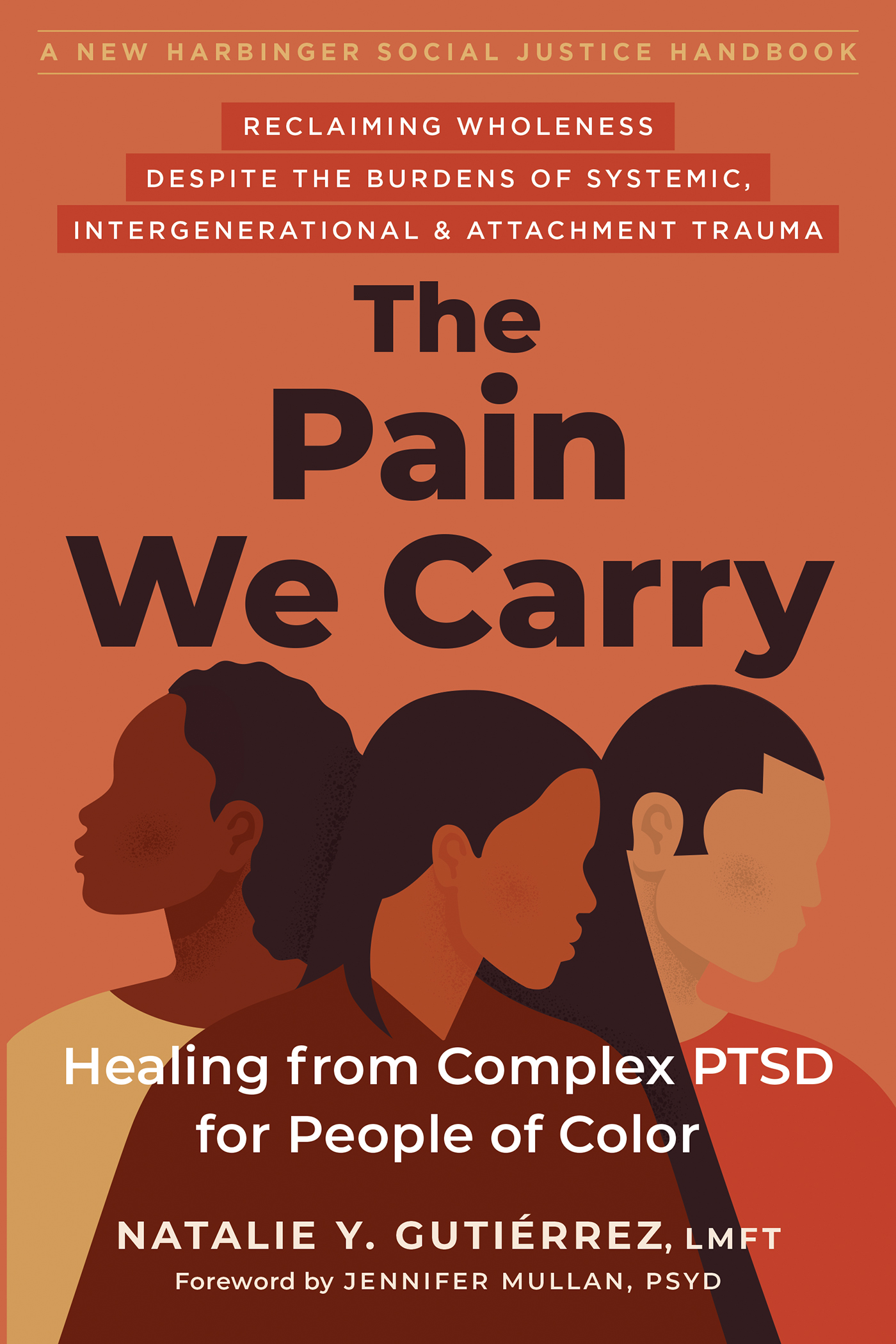
Natalie Y. Gutiérrez’s The Pain We Carry is a guide for people of color who are struggling with complex posttraumatic stress disorder. Gutiérrez organizes the book around a “Cultural Empowerment Approach” and names four cultural legacy burdens: racism, patriarchy, materialism, and individualism. She also outlines four “empowerment steps” that readers can take to address the impacts of these burdens: somatic self-regulation, mending shame with self-compassion, connecting with ancestral wisdom, and living intentionally. The Pain We Carry also includes many practices that readers can use to explore their personal histories and stimulate growth and healing.
Key Concepts and Notes:
- I am not the target audience for this book, but a friend and colleague of mine recommended it as a way to further my understanding of racial trauma and recovery. I tried to approach the book as a curious outsider peering into a conversation that I’m not directly engaged in but can learn from.
- Gutiérrez’s writing is gentle and warm, and she discloses significant aspects of her personal life as a means of relating to the reader. She also includes the stories of other people to illustrate how complex posttraumatic stress can play out in real life.
- The central offering of Gutiérrez’s work is a path to personal healing that will help people of color assume an interdependent stance from which to survive and thrive amidst systems of oppression. I like her focus on personal growth since it seems much more practical and attainable compared to larger goals for which Gutiérrez advocates, such as dismantling systemic racism.
- I can’t speak to the effectiveness of the proposed practices since I didn’t do them, but they are generally aligned with the kinds of exercises that therapists explore with clients to address traumatic stress and intergenerational trauma. Like all therapeutic tools, they will probably be helpful for some readers but not everyone.
- Two insights that I found particularly helpful were that “coping is not healing” and that the notion “love was supposed to hurt” can be very damaging to developing attachment systems (49, 100).
- Turning now to some critiques, I appreciated Gutiérrez’s opening statement that “Your discomfort and ambivalence are welcome here” (1). I certainly experienced a fair bit of discomfort and ambivalence while reading, for several different reasons.
- The first of these is that Gutiérrez’s framework is heavily steeped in Polyvagal Theory (PVT) and Internal Family Systems (IFS). While I have learned a lot studying both PVT and IFS, I have become increasingly skeptical of PVT’s neuroscientific claims and annoyed by the grandiosity of Richard Schwartz and other IFS devotees. The pervasive presence of PVT and IFS concepts made it harder for me to fully trust Gutiérrez’s scholarship. She makes little effort to engage with the broader therapeutic and neuroscientific literature.
- A related problem is that there are statements in this book that are factually incorrect. The most glaring of these is Gutiérrez’s claim that “Your prefrontal cortex (particularly your hippocampus) calms the emotion-centered part of your brain called the amygdala” (42). Anyone with a passing understanding of neuroanatomy knows that the hippocampus is not part of the prefrontal cortex, but rather the medial temporal lobe. Now, given the sentence structure, this error could be the result of poor wording rather than a true misunderstanding of the hippocampus’s location in the brain, but even if that’s true it doesn’t give me confidence that this book went through an appropriate editing process.
- There were other moments that registered for me as questionable depictions of complicated topics, such as Gutiérrez’s assertions that “Trauma is passed down through what is called in-utero exposure” and “All your experiences before the age of two are registered in your brain as implicit memory. After the age of two, your experiences are registered as explicit memory” (32, 120). The first statement is contested in the literature in a way that Gutiérrez fails to acknowledge, and the second statement is flatly untrue.
- At another point in the book, Gutiérrez outlines a protocol for washing a raw egg in salt water or Florida water and lemon juice, then rolling it all over your body to facilitate a “transfer of toxic energy” from your body into the egg, which you can then throw away (142). I imagine there are readers for whom that kind of practice will be appealing, but I’m not one of them.
- There are other features that may prove divisive, such as Gutiérrez’s regular invitations to take a break, stretch, get a sip of water, etc. I can see these moments landing as sensitive and supportive for some readers and irritating and condescending for others.
- My critiques and skepticism notwithstanding, I definitely think that Gutiérrez’s heart is in the right place, and I have no doubt that this book can be helpful to many people. I would just caution readers to treat it as one perspective amongst many, not a definitive take on this complex set of subjects.
Favorite Quotes:
You might feel uncomfortable as you’re reading when I say hard things about police brutality or White supremacy, especially if you’re a member of law enforcement, White, or other dominant groups (or have close proximity to them). Or perhaps a perspective of mine here differs from yours. And that’s okay. Your discomfort and ambivalence are welcome here. Journey with them as you begin to take the risk of opening your heart more to your experience. Your discomfort isn’t dangerous, and it has the ability to break you open to loving and seeing differently. Our discomfort can help make us aware of our biases and enable us to see our own vulnerability and that of others. Just know that all that’s written here comes from a place of love and openheartedness for you. (1-2)
My wish for you is to reclaim your self-love, your self-compassion, your self-care, your self-acceptance, your power, your nervous system, your body, your ancestral wisdom and healing, your community’s care, and your sense of belonging within it. To heal ourselves is to heal the generations that have come before us and to create a ripple effect for the ones that will come after. Our collective healing is imperative in this lifetime. Releasing the ancestral trauma and cultural legacy burdens carried in our minds, bodies, and spirits isn’t just some radical and idealistic idea––it’s surely our only route to liberation and wholeness. (14)
The goal is a balance between independence (self-reliance) and codependence (heavy reliance on others), which is called interdependence. Interdependence encourages us to care for ourselves individually, as well as to care for our communities through group healing. (26)
Coping is not healing. Your coping mechanisms are meant to be temporary and help you tolerate stress; they won’t heal you. (49)
You may have learned early in life that love was supposed to hurt, and you’ll need to unlearn this either before or after you find yourself in abusive relationships in adulthood, or perpetuate that abuse on to others yourself. Love is not synonymous with abuse and violence. To be clear, this doesn’t mean that people who’ve been abusive and explosive toward you don’t love you. I don’t think it’s that simple and that polarized. They might actually care a lot about you. But parts of them have learned to use violence to intimidate and get their needs met and gain your obedience. The child who is hit growing up says, “They hit me because they love me and I need to do better.” This same child eventually becomes an adult who partially believes that they deserve violence and punishment for expressing needs or living authentically in their relationships. If you were this child who was hit or dismissed, you will learn to dismiss your needs and boundaries just like in childhood. You unconsciously become your own punisher. (100)
The goal isn’t for you to relive old painful memories to retraumatize yourself in the name of healing. Your healing journey is more about facing and witnessing the parts of you carrying burdens, and then befriending and gaining the trust of these parts of you so that you can trust yourself better. It’s about reclaiming and reconnecting with yourself, your ancestors, and your community, while releasing all the cultural, legacy, and personal burdens troubling you that may have also lingered for generations. (108)
The burdens you carry may be heavy, but they’re not you. You are not the burdens you carry. I hope you can find the courage to slowly and steadily release them. Unburden the parts of you carrying the baggage of supremacy culture. The best revenge you can ever give toxic environments and people who’ve wounded you is your healing. (160)
Living intentionally and pausing to make choices that are most aligned with who you are and who you want to be, especially in difficult moments, helps break cycles of intergenerational trauma, release cultural and legacy burdens, and heal symptoms of complex posttraumatic stress. Because your ancestors were not given choice and power as a result of historical trauma, your efforts to live with intention in unjust systems become cardinal needs. This is your right. This is the food that feeds the soul. And like I said before: when it comes to you, you are the source. Your life of intention is the antidote to the trauma of injustice. Your commitment to live intentionally and authentically in your fullness will inspire others to do the same. The more you unearth your individual and collective power, the more courage you will have to change unjust systems, and rest in the process. You deserve your mental, emotional, physical, and spiritual freedom. Anchor yourself in that truth. (180)
Very fair review, beautifully written, totally agreed with your points. Thank you.
Thanks very much for reading and leaving this kind response! 🙂