SNQ: Sherry Turkle’s “Artificial Intimacy”
by Miles Raymer
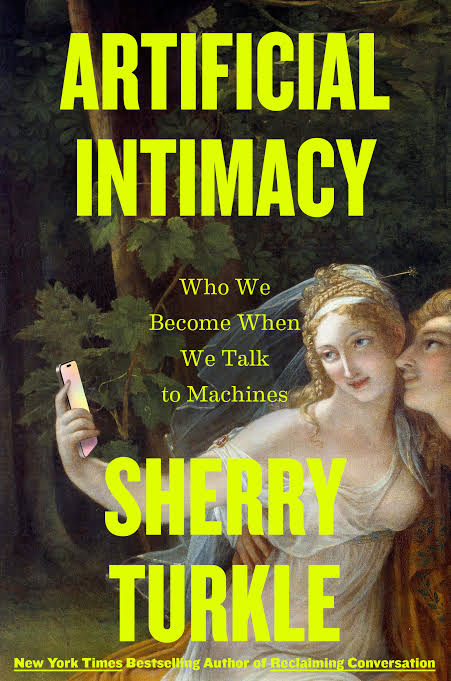
Summary:
Sherry Turkle’s Artificial Intimacy is an examination of how relationships between humans and artificial intelligence systems are reshaping our social world. Turkle doesn’t argue that people should abstain from AI use altogether, but she takes a strong position against human-AI relationships, which she characterizes as the point at which we “take a thing as an intimate” (215). The book explores how these new types of human-machine attachments are influencing some of our most important developmental arenas: childhood, adolescence, identity, love, work, therapy, and mourning. Written with passion and seasoned with Turkle’s deep understanding of how people interact with technology, Artificial Intimacy adds a useful set of ideas and perspectives to our urgent conversation about AI’s appropriate role in humanity’s present and future.
Key Concepts and Notes:
- I researched and wrote a clinical primer on artificial intimacy and attachment hacking earlier this year, so this topic has been top of mind for me lately. I think Turkle gives the subject a valuable but flawed treatment, one that powerfully presents but also overweights one side of the debate about the potentials and pitfalls of human-AI relationships.
- There is much to like about Turkle’s take, so I’ll start there before sharing some critiques. Turkle’s central thesis is that, although AI is useful for many things, it “needs to be kept in its lane” (41). Keeping AI “in its lane” means it would no longer be allowed to pretend to be in a relationship with a person. And “pretend” is the right word here because, on Turkle’s view, AI systems are incapable of having a true relationship with people because they haven’t lived a human life. Even if an AI developed an inner life of its own, it would be alien to us––“categorically the wrong partners”––and could only get better at “faking human subjectivity” (116). For readers who accept this view, I think it’s reasonable to conclude that we should, at the very least, be wary of allowing such an entity to occupy the role of a friend, lover, or any other significant attachment figure.
- At just over 200 not-so-dense pages of main text, Artificial Intimacy feels too short. Turkle does a good job of balancing research with vignettes from interviews with people engaging in various forms of human-AI relationships. These vignettes are probably the most valuable part of the book, and while Turkle may have leaned a bit too hard on them, I think that’s understandable given that the empirical research is lagging behind the phenomenon right now.
- Another strength is that Turkle has been researching this territory for decades, so she understands the landscape well and situates the current moment within its historical context. She has lived the “story of one step in front of the other” that led us here (215).
- Turkle’s main themes are the ways AI is reshaping our social expectations to the detriment of human-human relationships, the growth-promoting friction it fails to provide, the caring attachment figure it purports to be, its particular dangers for children and adolescents, the erosion of autonomy that comes with chatbot dependence, and its potential to degrade our capacities for cooperation and collective action.
- I think all of these concerns are legitimate and merit attention, but the ones I am most concerned about are AI’s effect on children and adolescents and AI’s threat to public life. I’m not sure if I’m at the point where I think kids should be banned from AI use entirely, but I absolutely believe that kids should be kept away from any form of AI companion. Turkle makes a compelling argument that minors are especially vulnerable because they are still forming their attachment templates, social skills, and identities, and I think everyone should be invested in making sure that AIs don’t take over that process.
- As a psychotherapist, I had a mixed reaction to Turkle’s chapter on my profession. I disagree with her that AI therapists should be avoided by default, and I think it’s likely that bounded-protocol therapy models will play a critical role in the future of mental health care. Of course I still hope there’s room for human therapists like myself, and while I do think that AI therapists should be off-limits for kids, we shouldn’t deny adults the option for an AI therapist if they want one. I agree with Turkle that we should be worried about client autonomy and dependence. A good therapist will work hard to help their clients develop the skills to eventually terminate therapy and live healthily without continued support, and we should demand the same from AI therapists. This could end up being in conflict with the bottom lines of AI therapy providers, so caution here is warranted.
- Turning now to my critiques of Artificial Intimacy, I think the book is too one-sided in a way that undermines Turkle’s credibility. She effectively highlights misuses of AI that are genuinely disturbing, but every chapter feels tailored to a predetermined conclusion rather than grounded in balanced scholarship on a hypercomplex and emerging field of research. She consistently presents judgmental interpretations of her interview subjects, often with the same “yes, they say it’s helping them, but I know better” tone. It’s condescending and elitist, and creates the impression that Turkle is incapable of considering the possibility that at least some human-AI relationships are net positive.
- Turkle only considers opposing viewpoints in passing and dismisses them too easily. She doesn’t give the idea of “relational pluralism”––that AIs will be additive to human-human relationships rather than competing with them––enough credence. Ironically, reading Artificial Intimacy actually made me more open to the relational pluralism argument because I kept trying to inject the nuance back into vignettes where Turkle seemed determined to flatten the person’s AI relationship into some version of a cautionary tale.
- I found myself almost completely rejecting Turkle’s take on how AI is changing the world of work. Turkle does point out the important problem that work has traditionally given people a sense of purpose, which we’ll need to address if AI takes over most or all jobs, but she doesn’t take seriously AI’s incredible potential for freeing up human creativity, banishing drudgery, and generating opportunities for new forms of meaningful labor that people will actually want to do rather than just doing whatever they have to to earn a paycheck and survive. Automating work that people don’t want to do is arguably the best use case for generative AI. While I do think we need to be careful with the speed of the job takeover and work to ensure that appropriate wealth redistribution mechanisms are in place to ease the transition, we should be welcoming this technology into the workplace rather than resisting it.
- I loved Turkle’s closing chapter, “Reclaiming the Real.” It’s true that, in this dynamic and scary moment, humans need to recommit to civic life and to our relationships with each other. I think the jury is out on whether the tension between artificial intimacy and human-human relationships is inherently zero-sum, or whether a positive-sum situation can emerge. But even if we’re headed toward a new horizon of relational pluralism, we should want human-human relationships to be both the norm and the gold standard for meeting our emotional, social, and developmental needs. Insofar as Turkle is championing this position, I’m with her.
Favorite Quotes:
My subject is artificial intimacy––AI that claims to care for us and proposes itself as a substitute for relationships with people. This is AI saying it will be there to sustain us as we try to meet the challenges of human life. That talking with us will be its vocation. That we will find comfort in its company and conversation. When we allow a chatbot to talk to us as though it were a caring person, when we use it as a best friend, lover, or therapist, we are in danger of losing something precious: the specificity of what we can give each other as humans. We’ve grown accustomed to treating programs as though they were people. Are we now prepared to treat people as though they were programs?
We love the objects we think with; we think with the objects we love. When we love our chatbots, we start to see the world through their eyes. We think of conversation as what they can deliver. We think of care as what they can provide. We think of empathy as what they can perform.
But chatbots can’t be empathic partners because they haven’t lived a human life. They don’t experience love. They don’t fear illness and death. They don’t know what it’s like to start out small and dependent and grow up so you’re in charge of your own life, but still feel many of the insecurities you knew when you were little. Without a body, they have no standing to talk about pain, fear, loss, joy, or passion. And they have no stake in our social world––our ability to live and work together in the real. (xvii-xviii)
Life on the screen changed our minds and hearts by making three promises. You can put your attention wherever you want it to be. You will always be heard. And you will never be alone. The promises were so compelling that we turned away from each other. Now chatbots extend the triple promise. If social media came for our attention, artificial intimacy comes for our capacity for attachment. When you talk to a chatbot, you have an audience that will always be on your side. You can have the feeling of a relationship without fear of judgment. People can’t make these promises. The chatbots and avatars of generative AI can. First we talked to each other. Then we talked to each other through machines. Now we talk directly to machines. (33)
Children should not be the consumers of relational AI, programs that pretend to have a self, capable of human-like connection. While the seductions of pretend empathy are dangerous for all of us, children have no defense; they are first-time learners. When an AI says, “I’ll always be on your side,” adults, hopefully, have had a lifetime of experiences that help them put that kind of comment into perspective. Adults have the experience of being connected to a person who accompanies them to a doctor’s appointment or stocks a refrigerator after a death in the family. Children haven’t had that. (80)
Why do we think a program could be anything other than alien? No matter how advanced an AI gets, it can only be ever more brilliant at faking human subjectivity. And what if an AI somehow develops its own inner life, with its own desires? No AI will have lived a human life, so it will not have had the experiences that allow humans to understand and find meaning in each other’s stories. As AI becomes a “subject,” it will assert itself as an alien. That is not to say that it won’t be interesting to talk to many species of chatbots. But when it comes to love, they are categorically the wrong partners. (116)
There is so much to say about AI and professional life. It’s changing who’s going to have a job and who won’t. It’s changing every aspect of management, leadership, and productivity. But work has an intimate dimension as well. At its best, work confirms a sense of identity and self-esteem. It gives us the opportunity to connect with our capacity for creativity and mastery. When we delegate tasks to AI, we risk losing these opportunities. (125-6)
Loss is the tragic motor of human development, the template for growth. (151)
The goal of therapy is for the patient to leave feeling more autonomous than before. Working with chatbots has had the opposite effect on Naomi, Emma, and Randyn. None of them can imagine life without the chatbot partner. (166-7)
Essig holds on to the belief that we can discipline ourselves to see chatbots as “objects that are not objects and subjects that are not subjects.” I think there has to be another choice––one that rejects the notion that chatbots are subjects of any sort. Chatbots are objects pretending to be subjects––and pretending is the very thing that therapists try to get patients not to do.
But I understand Essig’s reaction. As a clinician, he wants to be part of a conversation that accepts the world his patients live in, a world that includes more and more people having relationships with programs. The problem with my position is that if I say that artificial intimacy should not be in the repertoire of therapeutic relationships, I may be right, but irrelevant. (170)
You can train an AI to take a political position, but for the AI, it’s all theoretical. No program has a stake in the issues that face human communities: access to health care, educational opportunities, garbage collection, clean water, a minimum wage. When we spend a lot of time talking to voices with no interest in our communities, we lose interest as well. The idea of public life starts to feel abstract. As we lose the idea of a public, we unlearn the words with which to speak about the common good. We unlearn words like rights, responsibilities, representation, privacy. (207)
I’ve made the argument that it’s a losing game to take a thing as an intimate. You can enjoy a chatbot as a marvel, as a spectacle, you can improve the ways you use it as a tool, but when you say you are in a relationship with it, that’s out of its lane.
In retrospect, I could tell how we got here as a story of one step in front of the other. ELIZA was proof of concept. Tamagotchis showed that we were ready, with the smallest provocation, to love what we cared for. Social media made it seem natural to talk to each other through machines. Then came chatbots, and we’re talking directly to machines. But the fact that I could tell this story does not make where we have ended up any less extraordinary.
Now, I argue, against all odds, that we change course. First, we need to understand our vulnerability to chatbots. Then, mindful, we can devise a more intentional relationship with them. In therapy, when we consider our self-destructive behavior, the first step is to forgive ourselves and try to understand why we act against our best interest. The more we recognize our vulnerability to the virtual, the more we’ll be able to commit to the real.
But we’re finding it hard to commit to the real. Chatbots are appealing not only because of what they promise, but also because of what we’ve allowed to fall into disrepair––our care for each other and our commitment to our communities. All this neglect is part of our state of emergency. So, it won’t be enough to keep the programs in line. We need to address our withdrawal from each. (215-6)
Relationships with chatbots may be compelling; for some, inspirational or educational. But they don’t teach us what we need to know about the give and take of real relationships, or the friction, risk, and complexities of love. They don’t show us how to deal with loss by internalizing what is gone. They take on work assignments but don’t care if we have a sense of mastery or agency. They are good at keeping us busy, but can’t give us a sense of place. And they don’t teach us about empathy, or about human lives that are always embodied, social, and lived in shades of gray.
To say all this about chatbots does not diminish their importance. It puts them in their place. (218)
Glad to have read this, it makes me realise how many people are taken in by AI therapy sites and do not seem to realise from the first few chats that everything is skewed towards what the bot thinks you want to hear, to the point of nausea and disbelief. I feel for the people that take this seriously. I signed up for one out of interest in case it promoted some insights but I couldn’t stomach its fawning for more than two conversations and ended immediately with nearly all my trial month left to run. Everything is loaded with reassuring comments that ought not to take in anyone sincerely interested in tackling their mental health problems.
Thanks so much for sharing your experience, Frances! Sounds like a human therapist is definitely the right fit for you. 🙂