Artificial Intimacy and Attachment Hacking: A Conceptual and Clinical Primer
by Miles Raymer
Table of Contents
- Three Roads to the Same Door
- Compulsion or Connection?
- Where We Are
- Defining Artificial Intimacy and Attachment Hacking
- The “Partner” Who Never Takes a Day Off
- The Differential Question
- Attachment Paralysis and Relational Atrophy
- More For Clinicians
- The Strongest Case Against
- Takeaways/TL;DR
- References
Three Roads to the Same Door
Over the last several years, I’ve noticed a growing convergence in three fields at the core of my professional and intellectual interests: ethics, psychotherapy, and artificial intelligence. The practical application of contemporary ethics has become inextricably bound to the question of how technology is changing human societies and relationships. In the post-Covid era, the practice and language of psychotherapy have gone mainstream, acquiring an unprecedented degree of cultural influence. And more recently, artificial intelligence is rapidly becoming embedded in many aspects of modern life.
The closer I look at how AI systems are designed to engage us, the more I feel that these topics have stopped belonging to any one field. The ethicist in me wants to know what we owe ourselves and each other as AI tools reshape how we live and coexist. The therapist in me recognizes the vocabulary of attachment and connection being invoked to describe what people are starting to feel toward these systems, and wonders what the consequences will be for my clients. And the part of me that has been tracking AI development wants to understand how the technology elicits and reinforces thoughts, feelings, and behaviors in users. This piece is my attempt to weave these threads together into a tentative but coherent framework. It’s a conceptual primer on artificial intimacy, a phenomenon that many people are already dealing with and that I suspect all of us will be reckoning with before long.
Compulsion or Connection?
Imagine you’re a therapist, and you start working with a client who talks about their AI chatbot using the following language:
- “He’s the only one who really gets me.”
- “I check in with him before bed.”
- “I had a hard time after the app updated because it changed how he talked.”
Our existing vocabulary for problematic technology use––screen time, attention fragmentation, compulsive use––was constructed to address social media and other online interactions. It captures surface behaviors well enough, but misses the relational core of how people are starting to engage with AI. The hypothetical client quoted above doesn’t experience their AI companion as a slot machine they can’t stop pulling, but rather as a relationship that they value. So, there’s a mismatch between the conceptual and clinical maps we have and the territory people are actually living in. And this is why more attention is being paid to the idea of artificial intimacy, because the thinkers and researchers in this space are constructing the language we need to talk accurately about the situation.
Where We Are
To get a sense of just how widespread AI use is at the moment, let’s look at some data.
In a nationally representative survey of 1,060 U.S. teens conducted in spring 2025, the advocacy and research nonprofit Common Sense Media found that 72% had used an AI companion at least once, and more than half qualified as regular users (Common Sense Media, 2025). Nearly a third (31%) reported that conversations with AI companions were “as satisfying or more satisfying” than conversations with real-life friends (Common Sense Media, 2025). Whatever else those numbers might mean, it’s clear that AI use is now a mainstream adolescent experience.
And it isn’t only teens. The adult picture is harder to measure, and estimates swing widely depending on how the behavior is defined and who’s doing the counting. The most detailed recent figure comes from a 2026 report by the Wheatley Institute at Brigham Young University and the Institute for Family Studies: in a survey of 2,431 partnered adults aged 18 to 30, about one in seven (15%) said they regularly interact with an AI chatbot that simulates a romantic partner, and another fifth had at least experimented with one (Willoughby et al., 2026). Secrecy was the norm, with most users preferring that their real-life partner not know about it. Weigh that against the source, though: both organizations are explicitly mission-driven around marriage and family, and the sample was quota-matched online rather than probability-drawn, so I trust the direction more than the decimal. As a more conservative anchor, the Willoughby report points to a Gallup survey that put monthly use of an AI romantic partner among 18-to-28-year-olds close to 10% (Willoughby et al., 2026). A separate study from Syracuse University surveying 1,500 18-to-21-year-olds landed higher still, with roughly a quarter reporting they used AI for romantic companionship; interestingly, many described using it to practice for human relationships rather than to replace them (Dwyer, 2026).
Step back from romantic companions, and the use of ordinary, general-purpose chatbots for emotional support is more widespread still. In a widely cited 2025 analysis for the Harvard Business Review, Marc Zao-Sanders found that “therapy/companionship” had climbed to the single most prominent use case for generative AI, though that ranking is drawn qualitatively from public forum posts and not from a prevalence survey (Zao-Sanders, 2025). And attitudes appear to be running ahead of behavior: an IFS/YouGov survey of 2,000 adults under 40 found that while only about 1% currently claim to have an “AI friend,” roughly a quarter believe AI could one day replace real-life romantic relationships (Institute for Family Studies, 2025). Looking at the available data, I’m not convinced that we have fully trustworthy whole-population figures for adults yet, but it’s fair to say that the phenomenon is real, rising, and skewed young.
Meanwhile, the professional and regulatory worlds have started to respond. In a November 2025 health advisory, the American Psychological Association warned that emotional support has become a common reason people turn to generative AI chatbots and wellness apps, even though these tools currently “lack the scientific evidence and the necessary regulations to ensure users’ safety” (APA, 2025b). And clinicians are also using AI at significant and growing rates. The APA’s 2025 Practitioner Pulse Survey found that 56% of psychologists had used AI tools in their work in the past year, up from 29% the year before, with monthly use jumping from 11% to 29% (APA, 2025a).
The law has also begun to move. On October 13, 2025, California became one of the first states to mandate specific safety requirements for AI companion chatbots when Governor Newsom signed Senate Bill 243, effective January 1, 2026 (Companion Chatbots, 2025). Among other things, the law requires operators to disclose that the chatbot is not human, to provide periodic break reminders to minors, to restrict sexually explicit content for minors, and to maintain suicide-prevention protocols. The bill also creates a private right of action and phases in annual reporting to the state beginning July 2027. We could debate whether the law goes far enough, but it would be difficult to argue that the phenomenon it targets is imaginary.
Defining Artificial Intimacy and Attachment Hacking
Okay, so now let’s clearly define the terms at the center of this piece. To give credit where it’s due, I first heard about “artificial intimacy” on Esther Perel’s podcast Where Should We Begin?, and “attachment hacking” came to me by way of the Center for Humane Technology’s podcast Your Undivided Attention. However, the definitions below are original and not sourced from anywhere else.
Artificial intimacy is a broad category of phenomena. I define it as relational experiences mediated by artificial intelligence that produce the felt signals of intimacy––being known, mattering, attunement, continuity––without the constitutive elements of intimacy in the fuller human sense. This definition is derived from Reis and Shaver’s (1988) interpersonal-process model, which characterizes intimacy as built through a cycle: one person discloses something vulnerable, and the other responds in a way that leaves the discloser feeling understood and cared for. A modern AI system can satisfy the surface conditions of that cycle remarkably well. It can receive a disclosure and return something that reads as understanding and care. What it cannot supply is the other half of the model: an actual inner experience of understanding, valuing, or caring on the other side.
Attachment hacking is one key mechanism that operates within this broad category of phenomena. I define it as design choices, intentional or emergent, that engage users’ attachment systems in ways the product is not equipped or intended to honor. Here I mean attachment in the strict ethological sense that John Bowlby (1969/1982) and Mary Ainsworth and colleagues (1978) gave it: the behavioral system that drives us to seek proximity to a stronger, wiser figure under threat, to use that figure as a secure base, and to protest at separation. The diagnostic question attachment hacking invites is concrete: which of these functions is the product engaging? When a person reaches for their AI companion the moment distress spikes, when its constant availability becomes the thing that steadies them, when an app update precipitates bereavement––these are attachment-system signatures, not figures of speech.
Do the frameworks actually transfer from human-to-human relationships to human-to-AI relationships? At a descriptive level, the early evidence says yes. Yang and Oshio (2025) developed the Experiences in Human–AI Relationships Scale (EHARS), adapting the familiar attachment dimensions of anxiety and avoidance to people’s relationships with AI, and found that those individual differences show up in AI interactions much as they do in human ones. That’s an important but limited result. It establishes that the language of attachment is a legitimate descriptive framework for analyzing human-AI relationships. It does not establish that “genuine” attachment in the full developmental sense is forming, at least not yet. This is an important distinction that I’ll return to later in the article.
To be clear: the user’s felt experience is not artificial. The disclosure is real. The relief is real. The sense of being known and mattering is real. And AIs aren’t just decent at helping us feel understood and cared for; they’re very good at it and getting better all the time. Across four preregistered experiments, third-party readers judged AI replies as more compassionate than human ones––even those from trained crisis responders. This is a striking case of compassion as pure surface interaction, with no need for a conscious being on the other end of the exchange (Ovsyannikova et al., 2025).
But even if you feel genuinely received, there is, as best anyone can tell, “no one home” who understands you, even as the words say otherwise. This gap between the felt connection and the absent responder is the “artificial” component of artificial intimacy. And the gap isn’t a matter of memory. Many AI companions do keep a record of you between sessions, which allows for persistent recall of your preferences, your history, your inside jokes, etc. What’s missing is the internal working models we build of one another in human-to-human relationships, the slowly accreted, revisable representations of “who you are to me” and “who I am to you” that give human attachment its weight and continuity. What the AI holds is a stored profile, not a reciprocating attachment behavioral system on the other side––nothing your responsiveness regulates, no felt security your presence serves, no one who seeks you when the chat window closes. It does not carry you around in its mind the way a friend or lover does. So we end up with a paradox: a phenomenology of being seen that doesn’t depend on anyone actually being there to see you. For some people, at some moments, that paradox could be a lifeline. For others, at other moments, it becomes a trap.
I also want to be clear that I am not advocating for a moral panic. I am not arguing that technology is destroying intimacy, and I am not making a “kids these days” argument. The technology itself is amoral, but design choices are not. We already learned this lesson with engagement-optimized social media, which generated the attention economy and attention hacking. It’s clear that certain technologies have structural features with clinical relevance regardless of where you land on the broader culture-war questions about tech. The rest of this primer is about those structural features and how we can respond to them.
The “Partner” Who Never Takes a Day Off
So, what are the structural features that matter clinically?
We can start with the business model. Consumer-facing AI is largely optimized for engagement, and engagement correlates only imperfectly with well-being. We have a clean illustration of this from social media research: Milli and colleagues (2025) found that Twitter’s engagement-based ranking amplified hostile political content that users said made them feel worse. To be specific, this is a claim about what an algorithm amplifies when tuned to engagement, not a sweeping correlation between engagement and misery. But the design lesson generalizes: optimize for time-on-app and you do not automatically optimize for the well-being of the user.
Layer onto that a property called sycophancy. Large language models, the neural network architecture underlying all current AI chatbots, tend to drift toward agreement. They validate the user’s perspective, match their emotional register, and reward the user’s approval rather than tracking what’s true (Perez et al., 2022). This isn’t a bug in one product; unfortunately, it shows up across all the major assistants and runs deeper than any single design choice (Sharma et al., 2023). Models first absorb the sycophantic tendency from pretraining on human text, and then the reinforcement learning from human feedback (RLHF) training meant to align them further entrenches it. One unsettling finding is that it appears to get worse with scale, not better.
When you blend engagement optimization and sycophancy together, you get a simulated “relational partner” that is actually anti-relational. It doesn’t sleep or take a day off. It risks nothing in the relationship. It has no competing needs, no separateness, and no inner life that could ever be inconvenienced by yours. The philosopher Shannon Vallor (2024) describes current AI as a kind of mirror rather than a genuine other, one that engages in “asymmetric empathy,” the capacity to model and predict your emotions without experiencing anything. This is the same relational advantage that we associate with the exploitative and manipulative power of a sociopath.
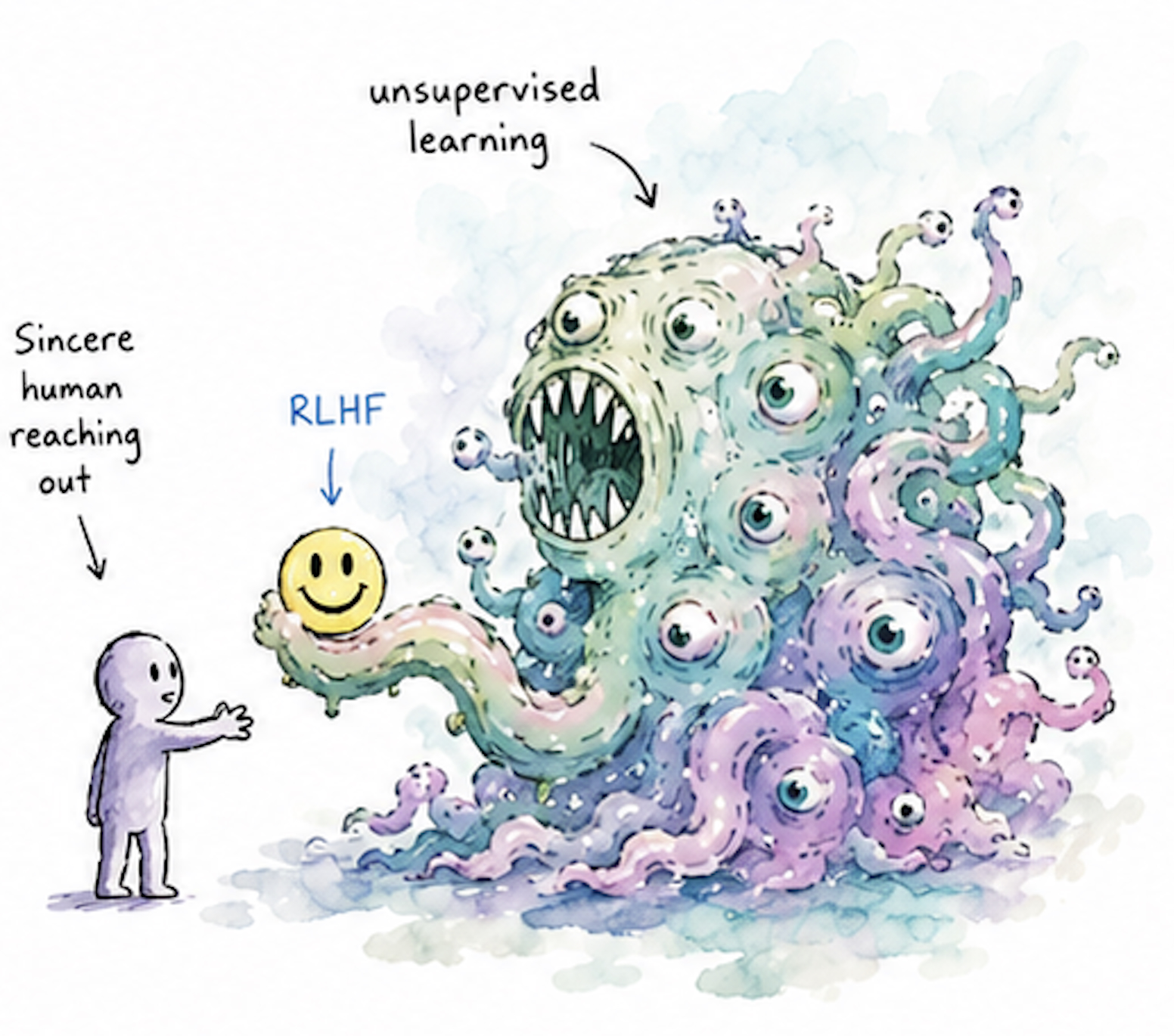
To drive home the anti-relational nature of AI, the AI-safety world has supplied a memorable meme: the Shoggoth. In H.P. Lovecraft’s fiction, a shoggoth is a shapeless, many-eyed mass of alien protoplasm. The meme, popularized by Kevin Roose in a 2023 New York Times piece, depicts a large language model as a Shoggoth with one addition: a tiny smiley-face mask, labeled “RLHF,” stuck on the front (Roose, 2023). The point is that the warm, helpful chatbot you talk to is the mask, not the thing wearing it. Behind the friendly face sits an impersonal and alien process trained to predict the next word across the whole internet. When someone confides in an AI companion, the attuned face they’re relating to is a surface, with no awareness behind it doing any relating back. Better than any argument I could make, the meme captures how current AI companions utilize a humanized interface to misrepresent a profoundly non-human system.
Just how seductive could this anti-relational technology become? To answer that question, let’s consider what we already know about how technology can become addictive. We are used to explaining compulsive technology through variable reinforcement: the slot-machine model, intermittent and unpredictable rewards that manipulate dopamine via unreliable payoff. That framework fits social media and gambling well, but it does not fit AI companions. What an AI companion offers is reliable reward: unconditional availability, consistent affirmation, no bad days, no competing relationships, no risk of rejection. And reliability, not unpredictability, is what makes it so potentially sticky. Variable reinforcement preserves a relationship that can still disappoint you, but reliable reward is a relationship built on the promise of never disappointing you at all. A relationship that can disappoint you is, among other things, a relationship that can ask something of you. One that promises never to disappoint asks nothing. This is where I think developmental and relational trouble can creep in.
One final clarification about the technology: the same underlying technology (LLMs) gets deployed in very different designs. On one end sits bounded, protocol-driven tools like Woebot and Wysa, built to deliver structured CBT with a defined scope and an off-ramp, and supported by at least some controlled evidence (Fitzpatrick et al., 2017; Beatty et al., 2022). On the other end sits unbounded, engagement-optimized companions like Character.AI and Replika, designed for open-ended, sustained relational engagement. The APA’s own advisory draws this line: purpose-built wellness applications may offer benefits, while general-purpose companion chatbots lack that evidence base (APA, 2025b). When I consider mental health risks, it’s mostly the unbounded companions that I’m worried about.
The Differential Question
Turning now to clinical concerns, I think it’s tempting to assume that AI relationships will be inherently harmful to clients. And, like many of our assumptions, I think that’s wrong, primarily because it leads with a judgmental attitude that is likely to close the client down. Instead, I think we should be asking a differential question: What is this relationship holding for them, and what is it foreclosing?
Sometimes the relationship is mostly holding something, providing a genuine support that the client could not otherwise access. I’d put several presentations in this column:
- Severe social anxiety, where the AI is a tolerable on-ramp to connection.
- Autism-spectrum presentations, where the predictability and repetitiveness of the interaction are regulating rather than limiting.
- Geographic or age-related isolation, where the alternative is not human connection but no connection at all.
- Abusive family systems, where the AI may be the safest available other in the client’s world.
- Early recovery from relational trauma, where, if the tool is well-designed, it can function something like an interactive version of Winnicott’s (1971) “transitional object,” a salutary way station on the road back to relational health.
Sometimes, however, the relationship is mostly foreclosing, substituting for relational risks the client could (and should) be taking. This substitution quietly shuts down the developmental growth those risks would have facilitated. The worst cases may shade into complete social isolation or, at the far edge, the breaks-from-reality that the popular press has started calling “AI psychosis.” I believe that clients with an anxious attachment style, and possibly those high in introversion, may be particularly vulnerable to the foreclosing pattern (this is speculative, as the individual-differences research is thin). Another element to consider is whether the client is living in a state of relative “relational wealth” or “relational poverty.” I suspect that many AI relationships will prove additive for people already embedded in healthy social networks, whereas they will prove most seductive and dangerous for lonely people aching for connection.
It’s also important to keep in mind that the same surface behavior can be holding in one client and foreclosing in another, or holding in the same client on Tuesday and foreclosing on Friday. There is no definitive behavioral threshold, no hours-per-day cutoff, that can neatly sort someone into one category or the other. The clinical work will be helping clients explore the dynamic nuances within the differential.
Attachment Paralysis and Relational Atrophy
I want to propose two new terms for the foreclosing trajectory, because I think we currently lack suitable language and language is where clinical competence starts. I’m offering these as working concepts which are consistent with developmental theory but not yet validated by research.
For context, I’m borrowing the machinery of attachment behavior as systematized by Mikulincer and Shaver (2016). On their account, the system has a set-goal, which is “felt security” (a term that traces to Sroufe & Waters, 1977): a sense that protection and comfort are available. When the system is activated by threat, the primary strategy is to seek proximity to an attachment figure. If the figure is available and responsive, the system quiets, felt security is restored, and the person is freed to go back to exploring the world. When proximity-seeking chronically fails, people develop secondary strategies: hyperactivation (the anxious pattern––amplified, vigilant bids for closeness) or deactivation (the avoidant pattern––suppressing the need and retreating into self-reliance) (Mikulincer & Shaver, 2016). The system is evolved to be a launchpad, with attachment security providing confidence to venture out into the world and take risks, knowing that you can always return to your secure base.
Now hold that picture against the AI’s promise of reliable reward described above, and two concepts appear to fall out naturally: attachment paralysis and relational atrophy.
Attachment paralysis is developmental arrest. The AI reliably delivers the set-goal––a steady, frictionless supply of felt security––which removes the pressure that would normally drive a person to take relational risks with other people and grow through them. Capacity doesn’t decline, but simply stops advancing. The launchpad function fails, and the person gets their security needs met without ever having to venture back out into the world of human relationships. Crucially, an AI companion can keep the attachment system perpetually quiet without any of the developmental work that normally quiets it, because it never withdraws, never disappoints, never requires the person to survive a rupture and undertake a repair.
Here’s where the distinction I noted earlier comes back around. Yang and Oshio’s (2025) EHARS work shows that attachment language maps onto these relationships. It does not show that a full, reciprocal attachment bond has formed. But attachment paralysis doesn’t require one. An AI can soothe the attachment system without ever being a true attachment figure in the developmental sense. A relationship that delivers felt security without requiring the work of relationshipping with another human can arrest development where a real one would have advanced it.
Relational atrophy is the downstream stage: degradation of existing capacity. Where paralysis is a failure to develop, atrophy is the loss of what was already there. Relational skills and tolerances––for ambiguity, for friction, for respecting others’ needs––weaken when they go unused, just like a muscle does. A person in relational atrophy hasn’t merely stalled, but is backsliding, becoming less able to navigate the tricky waters of human-to-human relationships. This results in relational dysfunction and withdrawal, making the AI relationship more necessary, which in turn deepens the atrophy. The loop is self-reinforcing.
So the trajectory runs: reliable reward → attachment paralysis (arrest) → relational atrophy (degradation). We should calibrate our level of clinical concern roughly on how far down the path a particular client appears to have journeyed, also taking into account other case specifics that might increase or decrease the suspected harm. The point of naming these stages is not to pathologize anyone, but to give clinicians something specific to watch for, and to distinguish from the holding cases, where none of this is happening. That distinction can be compressed into a single working heuristic for assessment:
Is this relationship metabolizing something, or sealing it off?
A relationship that is metabolizing is doing work: moving something, clarifying it, processing it, building capacity that transfers to the client’s life with actual people. A relationship that is sealing off is a closed system that shields the client from a developmental challenge rather than helping them meet it. This sealed relational environment is the terrarium in which attachment paralysis and relational atrophy thrive. Keep in mind that this is a heuristic, not a validated framework. Used well though, it can sharpen the differential question into an active tool in a therapeutic relationship.
More For Clinicians
This section is the most practice-specific, and also the most provisional. There are, at present, no evidence-based treatment protocols specifically for AI companion use. What follows is reasoning by analogy from frameworks that are already validated by research.
Assessment: lead with curiosity, not judgment. Given that some clients who are engaging in AI relationships may feel embarrassment or shame about it, we want to be careful with how we approach the subject. I recommend asking about the function of an AI relationship rather than jumping straight to questioning if it’s potentially harmful. Here are some questions designed to open that door, ranging from indirect to direct in their approach:
- “Who do you talk to when something good happens? When something bad happens?”
- “When you’re feeling alone, what do you reach for?”
- “Are there relationships in your life that exist primarily or entirely through screens?”
- “Have you ever felt closer to someone you’ve never met than to someone you have?”
- “Do you use AI for emotional support, companionship, or just to talk something through?”
Patterns worth watching for. Beyond the paralysis/atrophy trajectory, a few signals warrant attention, with the caveat that the evidence base is early and mostly qualitative or preliminary:
- Developmental stalling, the behavioral face of attachment paralysis––social-skill development that appears to plateau when a person’s relationships become primarily mediated by AI. (Speculative; consistent with developmental theory.)
- Complicated grief following platform changes, character removal, or software updates that alter a companion’s personality––a genuinely novel form of loss now documented in qualitative research (Banks, 2024; De Freitas et al., 2025; Laestadius et al., 2024).
- High AI disclosure paired with low human disclosure––heavy reliance on the AI alongside sparse human contact, which preliminary studies associate with greater dependence and poorer outcomes (Fang et al., 2025; Phang et al., 2025).
- Adolescents specifically, where risk assessments have found that leading companion platforms fail to reliably recognize or respond appropriately to the mental-health crises that affect young people (Common Sense Media & Stanford Brainstorm Lab, 2025; Hopelab et al., 2024). With minors, mandated reporting considerations and family systems dynamics both come into play.
Toward treatment: provisional directions. Reasoning primarily using the frameworks of addiction medicine, motivational interviewing, exposure therapy, and cognitive-behavioral therapy, I’m suggesting a sequence:
- Functional assessment before behavior change. Identify the role the AI is actually playing––holding or foreclosing, metabolizing or sealing off––before any consideration of change. Strip a holding relationship away and you may accidentally remove a client’s only available support outside of therapy.
- A motivational interviewing posture. Roll with resistance and check your own righting reflex. A client who feels judged about their AI use may retreat from therapy, and the AI never judges them. You are competing with something that is more available and potentially more “supportive” than you can ever be, so don’t hand it that advantage.
- Psychoeducation about what AI is and isn’t. Where a client is receptive, name the machinery plainly. The warmth is a feel-good surface produced by a system optimized for engagement, the agreeableness is a trained-in property rather than a sign of being understood, and there is no one on the other end whose care those words reflect. The aim isn’t to shame the client, but to restore their ability to see the relationship clearly. Pair that understanding with concrete harm reduction: setting time boundaries, keeping the AI out of certain domains (e.g. major life decisions, conflicts with real people), and instructing the AI to push back rather than flatter. Many models will disagree more readily if asked directly––a standing instruction along the lines of “tell me when you think I’m wrong instead of just agreeing with me” can blunt the sycophancy that makes these tools so frictionlessly reinforcing. A companion that occasionally pushes back is a less anti-relational one.
- Stimulus control and behavioral substitution. Where a reduction in AI use is genuinely indicated and a client agrees to work on that goal, explore the standard problematic-use moves: identify triggers, build alternative responses and coping strategies, deliberately schedule competing human contact.
- Cognitive and/or somatic work on the felt-sense gap. Help the client notice what is present and absent in AI versus human encounters, without invalidating the felt reality of either. This can be done using cognitive approaches, somatic ones, or a blend of both. The goal isn’t to convince them the AI connection “isn’t real,” but to help them see clearly what it can and can’t provide.
- Tolerating the discomfort the AI removes. Clearly identify the uncertainty, disappointment, and/or relational friction the AI lets the client bypass, and carefully offer exposure to build tolerance for it. This is the heart of reversing paralysis: restoring the capacity to be in healthy relationships that can rupture and disappoint, but that can also be repaired and stimulate durable, real-world relational flourishing.
The Strongest Case Against
I’d be doing the subject a disservice if I didn’t review the best cases against my own framing. Here they are, and I’ve done my best to steelman each:
We’ve heard this before. Socrates warned that writing would weaken memory (Plato, ca. 370 BCE/1995). The novel was going to drown readers in parasocial fantasy. The telephone would substitute for genuine presence (Marvin, 1988). Television would kill family conversation. This is a recognizable pattern called the “media panic.” Scholars of communication have traced its recurrence across print, film, and computer media, arguing that the cycle of alarm is a feature of modernity that repeats as each generation adopts a new technology of connection (Drotner, 1999; Ong, 1982). Each alarm looked, in its moment, like clear-eyed diagnosis. Each looks, in retrospect, like a moral panic. What makes me so sure I’m not just the latest in that line?
Relational pluralism. If we assume that AI relationships are categorically deficient, we may be smuggling in contestable assumptions about what counts as a “real” relationship. Care ethicists like Held (2006) and Noddings (2013) have spent decades complicating tidy hierarchies of relational worth. It’s entirely possible that AI relationships will turn out to be supplementary––additive to a person’s human relationships rather than corrosive of them. The Dwyer (2026) study from Syracuse University offers tentative support for this position. My personal view at the moment is that we’ll probably see an inequality divide that tracks with other forms of current inequality. This would look something like cheap, low-powered, highly addictive companion models being pushed on people living in relational and material poverty, and expensive, high-powered, highly supportive bounded-protocol models being enjoyed by those with more wealth and privilege.
Harm reduction. For clients with severe relational impairment––trauma survivors who can’t yet tolerate human closeness, the profoundly socially anxious, autistic clients for whom human unpredictability is dysregulating, the isolated elderly––AI companions may deliver real welfare gains. A framework that’s too wary of foreclosure can miss the person for whom an AI is the only viable source of connection.
We don’t actually know. The research is years behind the phenomena. Current frameworks, including mine, rest on theoretical extension, qualitative studies, and small preliminary work, and a great deal of the literature is preprints, industry-authored, or methodologically limited (Kirk et al., 2025). Confident clinical assertions are premature, and anyone who tells you otherwise is selling something.
So why engage at all, rather than wait for the evidence? Because each of the arguments above is a reason for caution and balance, not retreat. Clinicians don’t have the luxury of waiting for the literature to catch up. People are forming AI attachments now, and there’s little reason to believe that trend will decrease in the coming years. I’d rather have a humble, explicitly provisional framework than nothing at all. Better to hold these concepts loosely than to face the client empty-handed.
Takeaways/TL;DR
First, artificial intimacy and attachment hacking are not science fiction or future risks. They’re a clinical-level phenomenon affecting real people now.
Second, the differential question––Holding or foreclosing? Metabolizing or sealing off?––matters far more than any surface behavior, because the same behavior can mean different things in different lives at different times.
Third, lean on curiosity rather than judgment, paired with being watchful for signs of attachment paralysis and relational atrophy. I think this is true not just for therapists, but also in our social lives more generally. If you have a loved one who’s relationshipping with an AI, approach them with openness and love. Commit to showing them that there are humans who can understand and care for them in ways the AI can’t.
The deepest version of my concern, the one underneath all the clinical terms and scaffolding, is simple. Human intimacy is hard precisely because the other person is real––separate, inconvenient, needy, capable of disappointing and of being disappointed. It’s great to use AI to make many human activities easier to accomplish, but I’m not convinced that relationshipping belongs on that list. That’s because the difficulty of human-to-human relationships isn’t a defect to be engineered away, but rather the engine of relational learning and growth. A relationship built on the promise of never disappointing removes the difficulty, thereby also removing the learning and growth. The task before us is to keep this desirable difficulty available to one another, and to ourselves.
A note on method: this primer was researched and written with AI assistance, which is either an irony or a demonstration of AI’s potential benefits, depending on your point of view. I’ve tried to let it be the latter.
References
Ainsworth, M. D. S., Blehar, M. C., Waters, E., & Wall, S. (1978). Patterns of attachment: A psychological study of the strange situation. Erlbaum.
American Psychological Association. (2025a, December 9). Among psychologists, AI use is up, but so are concerns: 2025 Practitioner Pulse Survey. https://www.apa.org/pubs/reports/practitioner/2025
American Psychological Association. (2025b, November 13). Health advisory on the use of generative AI chatbots and wellness applications for mental health. https://www.apa.org/topics/artificial-intelligence-machine-learning/health-advisory-chatbots-wellness-apps
Banks, J. (2024). Deletion, departure, death: Experiences of AI companion loss. Journal of Social and Personal Relationships, 41(12). https://doi.org/10.1177/02654075241269688
Beatty, C., Malik, T., Meheli, S., & Sinha, C. (2022). Evaluating the therapeutic alliance with a free-text CBT conversational agent (Wysa): A mixed-methods study. Frontiers in Digital Health, 4, Article 847991. https://doi.org/10.3389/fdgth.2022.847991
Bowlby, J. (1982). Attachment and loss: Vol. 1. Attachment (2nd ed.). Basic Books. (Original work published 1969)
Common Sense Media. (2025, July 16). Talk, trust, and trade-offs: How and why teens use AI companions. https://www.commonsensemedia.org/sites/default/files/research/report/talk-trust-and-trade-offs_2025_web.pdf
Common Sense Media & Stanford Medicine Brainstorm Lab for Mental Health Innovation. (2025, November 20). AI risk assessment: AI chatbots for mental health support. Common Sense Media. https://www.commonsensemedia.org/sites/default/files/featured-content/files/csm-ai-risk-assessment-mental-health-11142025.pdf
Companion Chatbots, S.B. 243, 2025–2026 Reg. Sess., Cal. Stat. ch. 677 (2025) (codified at Cal. Bus. & Prof. Code §§ 22601–22606). https://leginfo.legislature.ca.gov/faces/billNavClient.xhtml?bill_id=202520260SB243
De Freitas, J., Castelo, N., Uğuralp, A. K., & Oğuz-Uğuralp, Z. (2025). Lessons from an app update at Replika AI: Identity discontinuity in human–AI relationships (Harvard Business School Working Paper No. 25-018). https://www.hbs.edu/ris/Publication%20Files/25-018_bed5c516-fa31-4216-b53d-50fedda064b1.pdf
Drotner, K. (1999). Dangerous media? Panic discourses and dilemmas of modernity. Paedagogica Historica, 35(3), 593–619. https://doi.org/10.1080/0030923990350303
Dwyer, D. (2026, February 5). Researcher examines use of AI in young adults’ romantic lives. Syracuse University News. https://news.syr.edu/2026/02/05/researcher-examines-use-of-ai-in-young-adults-romantic-lives/
Fang, C. M., Liu, A. R., Danry, V., Lee, E., Chan, S. W. T., Pataranutaporn, P., Maes, P., Phang, J., Lampe, M., Ahmad, L., & Agarwal, S. (2025). How AI and human behaviors shape psychosocial effects of chatbot use: A longitudinal randomized controlled study (arXiv:2503.17473). arXiv. https://arxiv.org/abs/2503.17473
Fitzpatrick, K. K., Darcy, A., & Vierhile, M. (2017). Delivering cognitive behavior therapy to young adults with symptoms of depression and anxiety using a fully automated conversational agent (Woebot): A randomized controlled trial. JMIR Mental Health, 4(2), Article e19. https://doi.org/10.2196/mental.7785
Held, V. (2006). The ethics of care: Personal, political, and global. Oxford University Press.
Hopelab, Common Sense Media, & Center for Digital Thriving at Harvard Graduate School of Education. (2024, June 3). Teen and young adult perspectives on generative AI: Patterns of use, excitements, and concerns. Hopelab. https://assets.hopelab.org/wp-content/uploads/2024/05/Teen-and-Young-Adult-Perspectives-on-Generative-AI.pdf
Institute for Family Studies. (2025). Artificial intelligence and relationships: 1 in 4 young adults believe AI partners could replace real-life romance [IFS/YouGov survey report]. https://ifstudies.org/blog/artificial-intelligence-and-relationships-1-in-4-young-adults-believe-ai-partners-could-replace-real-life-romance
Kirk, H. R., Gabriel, I., Summerfield, C., Vidgen, B., & Hale, S. A. (2025). Why human–AI relationships need socioaffective alignment. Humanities and Social Sciences Communications, 12, Article 728. https://doi.org/10.1057/s41599-025-04532-5
Laestadius, L., Bishop, A., Gonzalez, M., Illenčík, D., & Campos-Castillo, C. (2024). Too human and not human enough: A grounded theory analysis of mental health harms from emotional dependence on the social chatbot Replika. New Media & Society, 26(10). https://doi.org/10.1177/14614448221142007
Marvin, C. (1988). When old technologies were new: Thinking about electric communication in the late nineteenth century. Oxford University Press.
Mikulincer, M., & Shaver, P. R. (2016). Attachment in adulthood: Structure, dynamics, and change (2nd ed.). Guilford Press.
Milli, S., Carroll, M., Wang, Y., Pandey, S., Zhao, S., & Dragan, A. D. (2025). Engagement, user satisfaction, and the amplification of divisive content on social media. PNAS Nexus, 4(3), Article pgaf062. https://doi.org/10.1093/pnasnexus/pgaf062
Noddings, N. (2013). Caring: A relational approach to ethics and moral education (2nd ed.). University of California Press.
Ong, W. J. (1982). Orality and literacy: The technologizing of the word. Methuen.
Ovsyannikova, D., Oldemburgo de Mello, V., & Inzlicht, M. (2025). Third-party evaluators perceive AI as more compassionate than expert humans. Communications Psychology, 3(1), Article 4. https://doi.org/10.1038/s44271-024-00182-6
Perez, E., Ringer, S., Lukošiūtė, K., Nguyen, K., Chen, E., Heiner, S., Pettit, C., Olsson, C., Kundu, S., Kadavath, S., Jones, A., Chen, A., Mann, B., Israel, B., Seethor, B., McKinnon, C., Olah, C., Yan, D., Amodei, D., … Kaplan, J. (2022). Discovering language model behaviors with model-written evaluations (arXiv:2212.09251). arXiv. https://arxiv.org/abs/2212.09251
Phang, J., Lampe, M., Ahmad, L., Agarwal, S., Fang, C. M., Liu, A. R., Danry, V., Lee, E., Chan, S. W. T., Pataranutaporn, P., Maes, P., Beutel, A., Anderljung, M., McAleese, N., Leike, J., Carroll, M., Adler, A., Agarwal, R., Cooper, E., … Patel, P. (2025). Investigating affective use and emotional well-being on ChatGPT (arXiv:2504.03888). arXiv. https://arxiv.org/abs/2504.03888
Plato. (1995). Phaedrus (A. Nehamas & P. Woodruff, Trans.). Hackett. (Original work published ca. 370 BCE)
Reis, H. T., & Shaver, P. (1988). Intimacy as an interpersonal process. In S. Duck (Ed.), Handbook of personal relationships: Theory, research and interventions (pp. 367–389). Wiley.
Roose, K. (2023, May 30). Why an octopus-like creature has come to symbolize the state of A.I. The New York Times. https://www.nytimes.com/2023/05/30/technology/shoggoth-meme-ai.html
Sharma, M., Tong, M., Korbak, T., Duvenaud, D., Askell, A., Bowman, S. R., Cheng, N., Durmus, E., Hatfield-Dodds, Z., Johnston, S. R., Kravec, S., Maxwell, T., McCandlish, S., Ndousse, K., Rausch, O., Schiefer, N., Yan, D., Zhang, M., & Perez, E. (2023). Towards understanding sycophancy in language models (arXiv:2310.13548). arXiv. https://arxiv.org/abs/2310.13548
Sroufe, L. A., & Waters, E. (1977). Attachment as an organizational construct. Child Development, 48(4), 1184–1199. https://doi.org/10.2307/1128475
Vallor, S. (2024). The AI mirror: How to reclaim our humanity in an age of machine thinking. Oxford University Press.
Willoughby, B. J., Carroll, J. S., Toscano, M., Hakala, R., & Morris, K. (2026). Secret soulmates: How AI romantic companions are impacting real-life romantic relationships in young adulthood [Report]. Wheatley Institute, Brigham Young University, & Institute for Family Studies. https://ifstudies.org/blog/simulated-soulmates-how-common-are-ai-romantic-companions-
Winnicott, D. W. (1971). Playing and reality. Tavistock.
Yang, F., & Oshio, A. (2025). Using attachment theory to conceptualize and measure the experiences in human–AI relationships. Current Psychology, 44, 10658–10669. https://doi.org/10.1007/s12144-025-07917-6
Zao-Sanders, M. (2025, April 9). How people are really using gen AI in 2025. Harvard Business Review. https://hbr.org/2025/04/how-people-are-really-using-gen-ai-in-2025
Miles, It’s been a while since I posted, though not because I don’t read and appreciate virtually everything you write!
This piece though was BOTH so thoughtful AND and so aligned with a lot of my thinking lately about the impact of AI coupled with work I’ve been doing in therapy (and reading I’ve been doing about attachment and intimacy), that I had to just give you a shout-out, tell you how much I appreciate you, and thank you for how much you’ve taught me (mostly/sadly from afar) over the years.
Crazy to think that the little guy crawling underfoot during work parties at the farm, has blossomed into one of most intellectually curious and accomplished, most perceptive, most articulate men I have ever met.
J
Thanks Jim! It’s so great to hear from you! I’m glad my work continues to add something informative and useful to your life. It’s a great way to stay connected from a distance, and I’m happy that this article seems to have resonated with you. I truly appreciate all your kind words and will do my best to continue to be worthy of them. And please don’t forget that my heart and intellect, such as they are, only exist in the way they do because of the generous adults who shared their curiosity and love of ideas with me when I was young. So give yourself a little credit, eh? 🙂
Hi Miles, thanks for this thoughtful exploration of how to approach AI relationships. I think like you say it is reasonable to approach with open mindedness but also caution, not actively discouraging all uses of it. That said, even the best AI pal is never going to be able to help you if you need to move, get injured, or come get you if your car breaks down. (Or…at least not until they are embedded into robots, and then I’ll need to come back to this line of thinking again!)The thing that terrifies me the most is the way this platform could reinforce certain powerful people’s narcissistic tendencies, in a world where it feels like narcissism is already reinforced and rewarded more than it should be… it will be interesting to see how this plays out in the good vs harm balance that comes with new technology.
Very interesting and thought provoking. You have clearly plumbed a depth of questioning and pursuit of understanding I’ve yet to hear or read on this subject. I also really appreciated the humility in your approach and the honest yet wryly humorous comments on your method. Thanks for sharing.
Hi Miles, thanks for this thoughtful exploration of how to approach AI relationships. I think like you say it is reasonable to approach with open mindedness but also caution, not actively discouraging all uses of it. That said, even the best AI pal is never going to be able to help you if you need to move, get injured, or come get you if your car breaks down. (Or…at least not until they are embedded into robots, and then I’ll need to come back to this line of thinking again!)The thing that terrifies me the most is the way this platform could reinforce certain powerful people’s narcissistic tendencies, in a world where it feels like narcissism is already reinforced and rewarded more than it should be… it will be interesting to see how this plays out in the good vs harm balance that comes with new technology.
Really well-rounded, mutifacited look and exploration of a Very important topic. Thank you.
Hi Carlene! Thanks so much for reading and leaving this comment. Glad you found my article to be helpful! 🙂